"Immediate necessity makes many things convenient, which if continued would grow into oppressions. Expedience and right are different things."--Jefferson
Showing posts with label training. Show all posts

Friday, September 9, 2016

Fantastic Lesson Plan Resource for Mentors

Questions about mentor training?  Here you go!

I am training to be a Seminary teacher for my church and in the training, they outline how to make a lesson plan with the purpose of teaching principles so that the youth may apply them. It involved the "crust" skills (context and content) but puts them in their appropriate place as the overall goal of teaching in Vanguard is to change "cores" and strengthen them by helping the students seek for, recognize and identify true principles in all they learn in the world around them.

I have had many people ask me, "How do I seek for principles and teach them?"
This is the way.
Check out the learning videos: New Teacher Training Resource 
I would focus on lesson #9.  The lessons can be time consuming if done in their entirety but you can skim over them to get the gist.  In fact, if you review the lessons #5-8, you will see that they have taken the three step approach of knowledge, understand and intelligence and expanded it a bit, but it is the same basic idea, incorporating the core and crust concepts as well (without identifying them as such :).)
  • Understand the context and content-crust
  • Identify important doctrine and principles-knowledge-core/crust
  • Understand the doctrine and principles-understanding-core
  • Feel the truth and importance of those doctrines and principles-deeper understanding-core
  • Apply the truths in their lives-intelligence-core
 I love this!
In the above trainings, it suggests that you identify the different segments of material you want to cover and then determine which depth you want to take each one during class, since rarely can you cover all your material to application (at least I can't, by the time you want to add all those cool object lessons and application simulations :)!).

The following chart is fantastic and I can see so much potential in applying it in Vanguard!  For those who have been uncomfortable "winging it" (as I seem to do), here is a great way to start and for those of us who wing it because we feel like we have to, this is a remarkably concise way to organize and direct our lesson preparation to make it more effective.
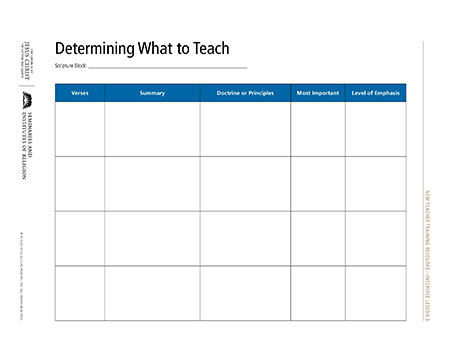
handout, Determining What to Teach
Lesson Plan Outline

Not only would mentors benefit from this but think about what would happen for our youth if they were able to take the material they were covering and weigh and apportion inspired depth with their different areas of study!

Ahhh...the possibilities.

Thursday, June 6, 2013

Importance of adult/mentor training

We must start with ourselves...you, not them, remember?

I came across this excerpt of a talk as I started my word study on leadership this morning:
Four years ago the presiding brethren launched a leadership training program. It began with the General Authorities themselves, in a school-of-the-prophets meeting each Wednesday in the Church Administration Building. They taught themselves in the leadership skills of Jesus and his prophets. From this modern school of the prophets came outlines and source materials for leadership training... (Wendell J. Ashton Conference 4/17)
We must go back to the basic principles as mentors, continually practicing what we want to preach in the years to come.  A mentor is simply someone who is at least one step ahead on the path that the student desires to be on!

We can do this through:
-Summer training of mentors
-Annual Parent Training Mentor meeting
-Monthly Mentor meetings

Saturday, May 25, 2013

Mentoring/Running Partners

James Ure of Williamsburg Academy stressed the importance of Weekly Accountability Meetings with your scholar, as well as their Student Accountability Reports. 

Here is a sample "running partner contract" that you could use as your youth enters into an agreement with you or some other carefully, prayerfully selected trusted adult mentor.

Then, you have weeking WAMs (as we call them at our house), where the youth gets together with their mentor.  Depending upon the needs of your youth, this can be a time to cheer them on, be stern, or supportively encourage...depending upon their personality.  The idea is that the mentor is a "running partner," someone who meets them for that "5 am running time" or "scholar phase" and is there for them to report to.  They may not come prepared week after week, and it is for the mentor to prayerfully decide what to do.  However, I have seen first-hand the power of regular accountability and how the youth will really rise up to use these tools as a means to not only accomplish great things, but even just to get into regular study habits.

Just to clarify a couple of terms on the forms below:
"commitment": do no matter what
"goal": shoot for the moon and go for it!

Here are some great examples of "SARs" (thanks to Marni, our techno guru):

Williamsburg version

Vanguard version

Vanguard version (2)

Vanguard version (basic blank)

Vanguard version (basic)

More visual one for visual learners or younger youth

Blank one to fill in with more versatility

I love having these with my daughter and my son reports to his father.  Very effective.

Wednesday, May 22, 2013

Teaching method videos

New link for videos from actual classrooms that show teachers using methods that are suggested in the learning activities in the Come, Follow Me outlines. These videos demonstrate how you can involve youth in searching the words of the prophets, and help them think about, share, and apply what they are learning. Some of the videos show how to effectively use visuals.

https://www.lds.org/youth/learn/learning-teaching-ideas/method-videos?cid=HP000054&lang=eng

Wednesday, May 8, 2013

New Resource blog for Vanguard

I decided that it would be too cluttered to have all the "nitty-gritty" games, book marks, schedules, individual group overviews for the year, etc. all on this site.

Sooooooo...I have started a "resource" site.  There is also a link on the side of the page. It is a site will all those things I listed. I am currently going through all my past emails that I have saved that I think could benefit a Vanguard group and adding resources.  Please, please, please feel free to email me anything you think would be beneficial to add.

I have only just begun, so it is still a little rough, but will be working on it more now that we will be having our last class for this year's Vanguard in our "Europe chapter" as Tova calls it :).

I hope you can take the time when you come across a great resource to forward it to me at biesingerm@gmail.com so I can put it on the site.

Thanks!

Monday, May 6, 2013

Notes from Marni's "Mentoring Tomorrow's Leaders" course

------------------
Mentoring is a fundamental form of development where one person invests time, energy,
and personal knowledge in assisting another person to grow and learn.

Give each participant an index card and ask them to silently do the following:
Identify one person, preferably someone who is not a relative, who was a mentor to 
them.

Think about why that person was important to them and the lasting effect that 
person’s interest had.

Recall the qualities of that person that made them so valued. Write down two or 
three of those qualities on the index card.

Have the participants talk briefly about the mentor they indentified and the qualities they 
valued. As they speak, list those qualities on the flip chart. When a quality is repeated, put a 
check mark next to it each time it is mentioned.

Review the items on the list. Highlight the items that were mentioned most often. Then 
have the participants identify which of the qualities might be categorized as 
“communication skills,” such as listening, talking, asking questions, and being 
nonjudgmental.

Allow time for participants to talk about their hopes and concerns in their new role. For 
example, which of the qualities they admired in their mentors do they feel fairly confident 
they possess? Which do they need to work on developing? What other concerns do they 
have about their role?

------------------------------
(Whether they all fit or not, but I thought even some would be good to identify...)
5 Phases of a Mentoring Relationship


Phase 1—Building trust
During the first phase of the mentoring relationship, it is critical for the mentor to be both 
predictable and consistent. During this time, the mentor and the mentee are exploring 
whether they can work together. They are determining the alignment of values, 
establishing a mutual respect, agreeing on the purpose of their relationship, and 
establishing roles and expectations.  
One thing that might happen is that the mentee might “test” how the mentor will react to 
certain situations. Be aware of this possibility, and handle these situations in an honest 
manner.
Ask: What are some things you can do to help build trust?
Look for the following:
When the mentor schedules a meeting, be there on time and ready.
Open conversations between both participants.
Both participants need to be honest.
The mentor needs to establish confidentiality and not share these conversations.
Ask: What happens if the mentor and mentee do not “hit it off” or fail to develop a mutual 
respect?
Accept that they should attempt to discuss and work out the differences. However, if either 
the mentor or the mentee is uncomfortable, then the process should end. The worst thing 
that could be done is to move forward when one of the participants has a personality 
conflict or a lack of respect for the other.

Phase 2—Setting direction
This phase is all about goal setting. Whereas in phase 1 the goal was to establish a sense of 
purpose, here the goal is to determine what the mentor and mentee should achieve through 
this relationship. It is important to set goals not just for the mentee, but for the mentor as 
well.
When setting goals, they need to be medium- to long-term goals that can be linked to 
shorter or even day-to-day goals. Goals should be SMART (specific, measurable, attainable, 
relevant, and time-bound).
Ask the participants to create and share goals that might be established during this process 
with a mentee. Have some of the participants share a goal and evaluate the goal for SMART, 
but not content.
The process of building rapport continues during this phase. It is important that mutual 
trust continues to be built while exploring the possibilities and the setting of goals.

Phase 3—Progression
This phase is the longest of the five. Here, both the mentor and the mentee become more 
comfortable about challenging each other’s perceptions, and they explore issues more 
deeply and experience mutual learning. Also, the mentee takes an increasing lead in 
managing the relationship and the mentoring process itself.
We will talk later about learning conversations, but for now know that these conversations 
are critical. This phase will focus on learning and problem solving; scaffoldings will be an 
important technique. Scaffolding involves providing resources and support as the mentee 
learns a new skill or concept in a manner that allows the mentee to grow beyond the 
support. As the mentor, you will not be expected to coach the mentee; however, you are 
expected to guide the mentee through a discovery process. The goal is for the mentee to 
develop through their own problem solving.
All relationships will experience their ups and downs, and these could occur here as well. 
There might be a few rough patches. Mentors should be prepared for this and not assume 
that something is wrong.  Continue to have open and honest conversations with the mentee 
to ensure that the mentee’s needs are being met.

Phase 4—Winding up
Now that the mentee has achieved a large amount of their goals, it is time to consider how 
the mentoring relationship will wind up. The mentee begins to plan how to continue the 
journey on their own.  
Ask: Why is it important to plan ahead for the end of the mentoring relationship?
Look for the following:
To avoid unhealthy dependency on either individual’s part.
To prevent hurt feelings by a sudden dissolution of the relationship.
To encourage maintaining confidence for further personal growth.
To mutually determine the roles of the mentor and mentee after the relationship.
To mutually determine how they will stay in touch beyond the relationship.
Winding up by celebrating the accomplishments is much better than winding down or 
drifting apart.

Phase 5—Moving on
This is about changing the relationship, often into a friendship where both parties can 
utilize each other as an ad hoc sounding board.
When this phase has been recognized as approaching and planned for appropriately in the 
fourth phase, it will ease the transition from the mentor-mentee relationship into one that 
has been mutually determined.

------------------------

The cornerstone of every mentoring event is the learning conversation. The mentoring 
process relies on your ability to create a reflective environment where the mentee can 
address their personal growth issues.
                                                       
To do this, a learning conversation has five components:
Reaffirmation—The mentor and mentee spend time to reestablish connectedness 
using more than just the normal social niceties. In a good relationship, there will be 
a mutual recognition of emotional states and the level of interest.
Identifying the issue—This is when the issue to be discussed is articulated and the 
mentee’s desired outcome is identified.
Building mutual understanding—The mentor encourages the mentee to explore 
the issue in depth, by asking questions that stimulate insight. The purpose of the 
questions is for both of them to more clearly understand the situation and all of the 
elements involved. The mentor wants to avoid offering solutions or analogies to 
their own experiences. When the conversation comes to a natural end, the mentor 
should summarize and check to see if a mutual understanding has been achieved.
Exploring alternative solutions—This is when both the mentor and mentee allow 
themselves to be as creative as possible, looking for ways to move forward. The goal 
is to build a range of solutions from which the mentee will eventually choose to take 
away for reflection.
Final check—The mentor encourages the mentee to review what they are going to 
do and why, and what the mentee has learned about the situation in question and 
about themselves. This allows for a mutual understanding and places the 
responsibility for what happens next on the mentee.
Between sessions, the mentee should be reflecting on what has been discussed how what 
they have learned relates to other issues. The mentor should also reflect upon their role in 
the relationship so the relationship’s progress can be measured.

--------------------


How to Kill a Conversation


For this section, facilitate the conversation with humor and keep it lively.
When you are having a conversation with a mentee, you need to be careful not to shut 
down a mentee’s thought process. Let them think things through. However, we sometimes 
say things that will kill a conversation without meaning to. What are some of the things you 
can say that will kill a conversation?
Examples:
Put down the mentee’s ideas—“That is silly” or “That is stupid.”
Speak judgmentally—“Why did you do that?”
Use abusive language, even if it is not about the mentee.
Sometimes it is not what we say, but what we do that kills a conversation. Who wants to 
show us some of these things?
Examples:
Do not make eye contact.
Slouch over.
Look distracted.
Drum your fingers on the table.
While the mentee is speaking, think about what you are going to say in reply. It is 
not possible to form your own words and concentrate on the speaker at the same 
time.
Interrupt the mentee while they are speaking.
Do something else (draw, make a shopping list, read e-mail, etc.)

-----------------------

Ask the participants “How important is it for our mentees to reach their goal?”
Point out that the mentee’s goal is an important part of the mentoring process, but it is not 
the point of the mentoring process. Remind the participants that the point of the mentoring 
process is the personal growth and development of the mentee. The project or goals are 
only a tool for facilitating that development.
However, we should not ignore the mentee’s goals during the process. As we have talked 
about during the action stage, we need to work toward the overall goal with small, planned 
steps. When exploring these steps and carrying out the action plan, we may discover the 
goal is not possible as the mentee originally envisioned and then help the mentee to 
develop a more realistic goal. 

-------------------------

Ask the participants, “How are we going to know if we are successful as a mentor in 
developing our mentee’s personal growth?”
Depending on your mentee and their needs, you should look to see if your mentee:
Begins to realize they have potential
Has an increase in self-confidence
Starts to think about the “bigger picture” and their role in shaping it
Ask the participants what are some indicators that their mentee is beginning to realize 
their potential?
Setting goals
Developing new skills
Beginning to practice time management skills
Ask the participants what are some indicators that their mentee has increased selfconfidence?
Has an increased cooperation with others
Believes in himself or herself
As the participants how can you tell if their mentee is beginning to think about their role in 
the “bigger picture?”
A willingness to help others
An ability to plan for the future
An understanding of how his or her goals and projects affect others
We are continually focusing on the mentee, and we should be, but how about you as a 
mentor? You will not be unchanged during this process. How do we measure YOUR 
growth?
Look for answers that include:
Gain new understandings through your mentee
Develop skills in teaching, coaching, and advising

--------------------------------------

“You cannot teach a man anything; you can only help him find it within himself.”—
Galileo Galilei

Parent Mentor Training...an essential key!

Okay...I just can't seem to get this out of my head :).

I cannot stress enough how essential parent-training is for Vanguard to be effective.  Parents need to be on-board, in the know, and, if not participating weekly, then at least doing Weekly Accountability meetings or coming the monthly parent mentor training meetings to make their youths overall experience in Vanguard a valuable training/learning experience and not just another social opportunity.

Over the years, I have seen good families show interest in Vanguard and then just drop off the youth, without using it the way it was designed.  It is set up in such a way as to allow the youth to develop their unique strengths, unique voice, and unique mission while meeting with like-minded youth and adults.  It is not a conveyor-belt class by any stretch of the imagination.

For instance, my son, Kel is now 15 years old.  He is mentored by his dad.  They sit down, look at the classes that are coming up in Vanguard and make commitments that will help Kel fulfill his personal mission and interests in those areas we are discussing.  For example, Kel is passionate about medicine right now.  We were studying Asia this last month and so we talked to him about presenting something about Asian medical advances or practices for the geography presentation.

The individual mentoring/guiding process doesn't need to be from the parents.  However, the parents have to know how to use Vanguard or how their youth can use Vanguard as an environment for their youth to practice sharing their unique gifts, as an environment to be supported in their pursuit of worthy projects, and as an environment for them to develop leadership skills.  Another instance from our family, my daughter, Tova, writes all our book marks.  The two kids take turns with me leading the devotional, activities and our weekly leadership discussion from our current chapter from 7 Habits of Highly Effective Teens or TJEd for Teens.  They decided we needed a game chief and a movie night supervisor, so they nominated and elected each other for that.  My daughter decided that she loves history so much (or wants to learn it better) so she has taken on teaching the more basic version of what we learn in our Vanguard History Class each week to my other kids.  My daughter has also designed a new blog for our family's personal use in Vanguard here in Europe.

The youth want to excel.  The parent mentor training and monthly meetings are ideal times to bring up the interests and needs of the youth, especially as they get older.  As groups allow themselves to be guided by the spirit, they will know how to incorporate/address these needs.

Accountability through these weekly mentor meetings complements the need for a youth to be prepared.  To be accountable in the home coupled with the feeling of wanting to be prepared to share make it a more successful experience for the youth as they make unique commitments, meet them, and have the satisfaction of sharing what they learned with like-minded youth.

I know that there are youth programs that require their parents to pay for and attend training programs.  These are effective in helping the parents get on board with the mission, vision, and tools used by their youth.  I do not feel that these programs need to cost something to make them effective.  If the parents could only see the value in getting together, refreshing themselves in an annual summer training and then monthly mini-trainings and discussions, they would be able to see such wonderful results.  There are benefits in not only reviewing the core principles of a group as ambitious as Vanguard, but benefits to be had by discussing and reviewing the tools and methods used in the class and how it can best meet the needs of the youth in that particular group.

Hope this helps someone :)!  Here's a link to a PDF example of a training that we had on a Saturday.  I think it should have been a two-day event, as we really rushed through everything and didn't have as much time as I would have liked for discussion and simulation.  I think that the more we can get our parents together, discussing concerns and successes, the easier it is to have everyone on board.

(Here is a different link just in case it works better for you.)


Heroes Journey

Someone shared this clip about the heroes we find in our stories and how those cycles apply to us in our lives. 

TED-Ed What makes a hero?

Friday, May 3, 2013

Education that allows our best to shine...

My daughter and I were discussing "Tom Sawyer" the other day.  My daughter writes the book marks for our group and in it she had the question:
Huckleberry was filled with admiration of Tom's facility in writing, and the sublimity of his language. What does this show about education? 
This really made me think and I answered her: "To be educated expands your influence and capacity to influence others.  People will listen to you more and be influenced by you more.  And, education spills over into every corner of our lives.  Our education can bring out the best that is within us, by giving us the means to communicate that best ."

 
I tried to describe it this way:  It's like the inside of us is covered with talent, insights, and abilities that are amazing and unique.  But they are trapped inside until we communicate them with the world. One of the purposes of education is to find mediums (art, poetry, song, writing, experimenting, speech, building, you name it!) that will give those talents, truths and perspectives voice and a path out of ourselves to be shared with others.  Although this probably lies in the realm of the "crust" of leadership, it is valuable for the "core to be communicated more effectively.

One of the parts of the overall mission statement of Vanguard Youth is:
Helping the youth find value in their own unique mission and introduce them to various communication styles so that they may communicate that mission to the world

A good education allows our inner genius to shine, giving it a path out of the inner recesses of our souls.


Thursday, May 2, 2013

The Vision We (Mentors) Should Have

I think this beautifully encompasses how we should plan for each year, how we should prepare for each week in class, and the mindset we should take there with us.

"I have pondered and earnestly petitioned our Heavenly Father to know how I might best be able to serve you tonight. I pray the power of the Holy Ghost will be with each of us—that we may think what we need to think, feel what we need to feel, and learn what we need to learn so we can do what we know we should do and ultimately become what the Lord yearns for us to become."


I love his use of the word "serve" in the first sentence, and the progression in the second sentence - think, feel, learn, do, become.


From Elder David A. Bednar's CES fireside talk "That We Might 'Not Shrink.'"

Monday, April 29, 2013

God's power made manifest through service!

Listened to this just now,...had to share:

I have learned a truth that has been repeated so frequently in my life that I have come to know it as an absolute law. It defines the way obedience and service relate to the power of God. When we obey the commandments of the Lord and serve His children unselfishly, the natural consequence is power from God—power to do more than we can do by ourselves. Our insights, our talents, our abilities are expanded because we receive strength and power from the Lord.

2012-2013 year in review and New Group info

It is exciting to see others enjoy the fruits of something I felt inspired to do for my own family and children.  I am excited to see the truths shared freely, openly, and see others bring their truths to the table and make it even better :).

As new groups start up, I feel the same hesitance I felt as I left my original group in the hands of very capable, wonderful people.  What I feel is my gift and ability and role in this is to explore this educational approach for youth, share the truths I find for my family and those that others have shared, and collect it in a...well, somewhat organized fashion on this blog.  I continue to see it bear fruit as my own children progress through scholar phase.  I don't feel that I can offer much more in the realm of particulars of the "how," as that is such an individual and prayerful application. Hopefully this blog will have a lot of resources for you to access and use as a spring board for your own group.

I would like to have general questions or concerns that come up in groups be posted on this blog, so that we may have open dialogue: like, "How do we get older youth to remain engaged?" or "How do others effectively engage or train parents and mentors?"...things like that.  For those who already have groups going, I think this end of the year time would be a valuable time to share learning experiences from this year.  What works for one group may not necessarily benefit another. However, as they say in the scouting acronym for TEAM, "Together Everyone Achieves More."

We could use this post for that kind of feedback.   Of course, I expect it to be a respectful forum for the exchange of ideas.  I figure this would be the case, but sometimes it is good to be reminded that there is a human heart on the other side of the internet connection :).

I also wonder if we could have the mentors of the different groups on the yahoo/blogger groups of the other groups?  I strongly believe in the power of synergy that comes when great ideas come together to become more, and feel that this could be a useful way of sharing.  The only concern I could see is if a group has personal info included on their sites.  What do y'all think?

I know this is a crazy time of year, so do what you can, but just wanted to have this place as an available forum for this kind of dialogue.

Woohoo!  The Vanguard grows and moves forward!

Thursday, April 11, 2013

The history of modern education...

The following is an incredible video...a must-see for all of us who have "come off" the conveyor belt of modern education.

We have certain mindsets, behaviors, and expectations that have come from our experience in public school, and we need to really look at what they are and where they came from, so we can use true principles and methods.  I particularly like what he said about the purpose of certain classroom techniques.

Like I said, a must-see!  Thank you so much, Genevieve, for sharing this!
********
A friend brought up an interesting point about the Seth Godin clip. :)  I was already thinking this, but just wanted to get it out for you all to know.

I should be careful what I throw out and endorse :).  I loved so much of what he said, but, as my friend said, he said some things at the end that I don't necessarily agree with.  As with champions of most any cause, he was extreme in some cases, and I didn't agree that all of it applied to me or was even all truth.

Case in point: I love the hypnobirthing method and highly recommended the book to a friend.  She hated it, saying that she didn't agree with everything the author said.  I was surprised, because, I, too didn't agree with everything, but loved the truth that was in it and the food for thought the points I disagreed with gave me.

Like is says in Moroni 10:3-5, seek for truth by the spirit and the Holy Ghost will bear witness of it.  Unfortunately, we live in an imperfect world, and the truth is hidden.  The Holy Ghost will help you know what is truth and what you need to do with it. 

But remember, the Holy Ghost may have different messages for different people:
-the Anti-Nephi-Lehis knelt in prayer even as they were slaughtered.
-Nephi took up the sword and slew a man who was lying helpless before him.

So judge righteously for yourself, and don't condemn the actions of others...good words to live by :).

Like was said in the most recent LDS General Conference, the most important thing we need to do in these latter-days is to be able to recognize, feel, and act on promptings of the Spirit.
Thanks, friend, for reminding me about that important clarification!

Friday, March 8, 2013

Resource/Training in how to mentor a Spirit/Truth-led classroom

The Church of Jesus Christ of Latter-day Saints has incorporated a new teaching program in their Sunday School classes for youth that parallels one of the basic principles of Vanguard Youth: that the youth should come prepared to share, teach, and learn from each other.

They have set up some training videos that, although they might not be comprehensive in application for an individual mentor's style or religion, there are truths to be gained and perpsective broadened when humbly viewed with the intent to seek truth.

Come, Follow Me training link

A neat quote from Boyd. K Packer about the blessing of having the spirit in our classrooms:
Each of us must stay in condition to respond to inspiration and the promptings of the Holy Ghost. The Lord has a way of pouring pure intelligence into our minds to prompt us, to guide us, to teach us, and to warn us. Each son or daughter of God can know the things they need to know instantly. Learn to receive and act on inspiration and revelation. ("These things I know" April '13)

This is an incredible promise to mentors and youth alike!

Karen had the following to say:
"I thought this was so incredibly insightful that I had to share it! Sometimes in a group like Vanguard or in your homeschooling environment, you may wonder if you are "learning enough" since there are no grades, no report cards and other measures. Elder Bednar shares some incredible insight in this video about how to tell if we are progressing as we should."

As youth get older...

It is both exciting and scary as the youth get older and seek to take more ownership in the group as they stretch their growing wings of leadership.  This is what we want, right?

Yet, it can be a little scary for a few reasons:
-less control--when you turn something over to someone else, it will look different
-less predictability--youth and new mentors might not know yet how to use the time, and you might have to deal with unexpected "over" and "under" time in class.
-your youth might "fail" in a public setting :).  Ouch :).

The safe environment that should be present in each Vanguard Youth group is an ideal environment for people to practice leadership and safely "fail."  They will learn from their mistakes and they will bring new ideas and perspectives.  If all are following the Spirit, the Spirit will orchestrate the class in unexpected, yet transformational ways.

As the youth begin to step into increasingly more responsible roles in Vanguard, one resource the adult leaders can use to help them understand their new role is the "shadow leadership" method of the Boy Scouts of America.  This is ideally a technique where the youth stands in the front of the group as a physical leader, while the adult watches, supports, and then mentors the youth before and after, giving suggstions and ideas and support.

As you start the new year and have youth, I feel that for it to be a true leadership education academy, you must solicit their help and input in what to include in the year.  (See post on "Planning a new year")

Tuesday, February 5, 2013

"Seek Learning" by Gordon B. Hinckley

Excerpts--well, I included most of it, because it is a quick-read and phenomenal.

"You have the potential to become anything to which you set your mind.
Many years ago I worked for a railroad. I was in charge of what is called head-end traffic. One morning I received a call from my counterpart in Newark, New Jersey. He said, “Train number such-and-such has arrived, but it has no baggage car. Somewhere, 300 passengers have lost their baggage, and they are mad.”
I went immediately to work to find out where it may have gone. I found it had been properly loaded and properly trained in Oakland, California. It had been moved to St. Louis. But some thoughtless switchman in the St. Louis yards moved a small piece of steel just three inches, a switch point, then pulled the lever to uncouple the car. We discovered that a baggage car that belonged in Newark, New Jersey, was in fact in New Orleans, Louisiana—1,500 miles from its destination. Just the three-inch movement of the switch in the St. Louis yard by a careless employee had started it on the wrong track, and the distance from its true destination increased dramatically.
There can be no doubt, none whatever, that education pays. Do not short-circuit your lives. If you do so, you will pay for it over and over and over again.
That is the way it is with our lives. Instead of following a steady course, we are pulled by some mistaken idea in another direction. The movement away from our original destination may be ever so small, but, if continued, that very small movement becomes a great gap and we find ourselves far from where we intended to go.
It is the little things upon which life turns that make the big difference in our lives, my dear young friends.
There can be no doubt, none whatever, that education pays. Do not short-circuit your lives. If you do so, you will pay for it over and over and over again.

Fulfill Your Potential

You have the potential to become anything to which you set your mind. You have a mind and a body and a spirit. With these three working together, you can walk the high road that leads to achievement and happiness. But this will require effort and sacrifice and faith.
You must get all of the education that you possibly can. Life has become so complex and competitive. You cannot assume that you have entitlements due you. You will be expected to put forth great effort and to use your best talents to make your way to the most wonderful future of which you are capable. Sacrifice a car; sacrifice anything that is needed to be sacrificed to qualify yourselves to do the work of the world. That world will in large measure pay you what it thinks you are worth, and your worth will increase as you gain education and proficiency in your chosen field.

The Lord Wants You to Be Educated

You have a mandate from the Lord to educate your minds and your hearts and your hands. The Lord has said, “Teach ye diligently . . . of things both in heaven and in the earth, and under the earth; things which have been, things which are, things which must shortly come to pass; things which are at home, things which are abroad; the wars and the perplexities of the nations, and the judgments which are on the land; and a knowledge also of countries and of kingdoms—that ye may be prepared in all things” (D&C 88:78–80).
The Lord wants you to train your minds and hands to become an influence for good as you go forward with your lives.
The Lord wants you to train your minds and hands to become an influence for good as you go forward with your lives. And as you do so and as you perform honorably and with excellence, you will bring honor to the Church, for you will be regarded as a man or woman of integrity and ability and conscientious workmanship.... Become a workman of integrity in the world that lies ahead of you.

Special Counsel for Girls

In this day and time, a girl needs an education. She needs the means and skills by which to earn a living should she find herself in a situation where it becomes necessary to do so.
The whole gamut of human endeavor is now open to women. There is not anything that you cannot do if you will set your mind to it...Set your priorities in terms of marriage and family, but also pursue educational programs which will lead to satisfying work and productive employment in case you do not marry, or to a sense of security and fulfillment in the event you do marry. Education will increase your appreciation and refine your talent.

Special Counsel for Boys

No boy anxious to please his Heavenly Father would fail to take advantage of educational opportunities. But there is a troubling trend taking place. Young men are more likely to drop out of school than young women. Women have earned more bachelor’s degrees than men.
It is plainly evident that young women are exceeding young men in pursuing educational programs. And so I say to you young men, rise up and discipline yourself to take advantage of educational opportunities. Do you wish to marry a girl whose education has been far superior to your own? We speak of being “equally yoked.” That applies, I think, to the matter of education.

More Than Secular Learning

Never before have so many been educated in the learning of the world. What a powerful thing it is—the intensive schooling of a large percentage of the youth of the world, who meet daily at the feet of instructors to garner knowledge from all the ages of man.
As we pursue our secular studies, let us also add to our lives the cultivation of the Spirit.
The extent of that knowledge is staggering. It encompasses the stars of the universe, the geology of the earth, the history of nations, the culture and language of peoples, the operation of governments, the laws of commerce, the behavior of the atom, the functions of the body, and the wonders of the mind.
With so much knowledge available, one would think that the world might well be near a state of perfection. Yet we are constantly made aware of the other side of the coin—of the sickness of society, of the contentions and troubles that bring misery into the lives of millions.
Each day we are made increasingly aware of the fact that life is more than science and mathematics, more than history and literature. There is need for another education, without which the substance of secular learning may lead only to destruction. I refer to the education of the heart, of the conscience, of the character, of the spirit—these indefinable aspects of our personalities which determine so certainly what we are and what we do in our relationships one with another.
Over fifty years ago while serving in England as a missionary, I went to the London Central YMCA. I suppose that old building has long since gone, but I can never forget the words that faced visitors in the foyer each time they entered. They were the words of Solomon: “With all thy getting get understanding” (Proverbs 4:7).
Understanding of what? Understanding of ourselves, of the purposes of life, of our relationship to God who is our Father, of the great divinely given principles that for centuries have provided the sinew of man’s real progress!
As we pursue our secular studies, let us also add to our lives the cultivation of the Spirit. If we do so, God will bless us with that peace and those blessings which come from Him alone.

Wednesday, January 23, 2013

Scholar Phase and Class time: Validation from TJEd for Teens

Objective of scholar phase and importance of learning tools:
"The purpose of Scholar Phase isn't to complete your learning, but to so immerse yourself in the habits of great learning that you keep using them to solve problems, improve yourself and your conditions in life, and to help others do the same for the rest of your life.  That's Scholar Phase." (pg 80)

Developing the habits of great learning is difficult.  It is important to remind them of the tools that can help them in scholar phase: the 4-R's, sharing, accountability, mentoring, etc.  These are an essential part of Vanguard!  Sometimes it is the process that teaches almost more than what is actually being discussed, especially as the youth are younger.  When they are older, they are able to actually use the tools to better educate themselves and share what they are learning.

How wonderful to be discussing truths and things of lasting importance as they are learning, so they are able to get both at the same time, unlike "exercise books" that have meaningless examples for which them to practice the tools they are learning.

Purpose of Class time: Inspiration!
"The purpose of class time in great education is not study, but rather 1)inspiration, 2)answering questions, and 3)more inspiration." (pg 82)

Vanguard is such an ideal set-up for letting the youth use the scholarship they are learning in their private studies while at home to inspire their peers and be inspired back :)!

When is it good to be wrong as a mentor?

I think being real is so important as a mentor!  It not only makes you relate-able, but also allows you to be taught by those you are mentoring, among other things.

This article by Rachel DeMille I saw this morning gives more of those great reasons to be a humble mentor!

Of course, the biggest reason to be humble is because then God can more easily mentor you and those you are mentoring, and, as my dear friend Michele Smith said, He is the best and truest mentor you can have :).


Wednesday, July 11, 2012

Writing Inspirements

I wrote the following for our group and I thought it might be useful for others, so I'm posting it here:

I hope we can help each other find ways to come up with powerful, motivating, meaningful inspirements.  These inspirements are an invitation to the youth to act. As they act on their knowledge, they will be blessed with the spirit and a higher capacity for truth and understanding.  Following is the process I go through when writing inspirements. Feel free to share more insights and ideas as you learn them.

1. Get an overview of the subject
F.A.C.E. talks about the importance of whole to part leaning.  It is important that we understand how this subject (history/geograhy, art/imaginative literature, math/science or government/leadership) fits into building of the kingdom of God.
Some good books for this are:
How Should We Then Live?
Gateway to the Great Books introduction
The Noah Plan books: History and Geography for Geo Conquest
          Literature and Stonebridge Art for Imaginative Arts
          Science and Mathematics for Face to Face with Einstein
         The Christian History of the Constitution of the United States (also explains how other             cultures and time periods have contributed to forming a country of freedom) for Leadership Academy

2. Get an overview of the time period:
The above books or
The History of the Medieval World by Susan Wise Bower

3. Find seven points of focus - events, people, creations (by God or by people), or ideas that I want to focus on - one for each month.

4. Find and read a classic and some background that pertains to that event, person, etc.

5. For each focus, as I read, I ask myself what would Heavenly Father want me to take away from this event, person, etc.?   What might he want the youth to take away from it?  What truths about how we ought to live are found here?  The answers to these questions help me find principles and ideas to focus on.

For example, when I was getting ready to teach Confucius, I was inspired by how hard he tried to get into a position of influence, but never could.  People knew he spoke truth, but did not want to give up their power.  He died having never achieved his dream of governing a people in the government he envisioned.  However, we, thousands of years later, know who he is and the truths he spoke.  There were several principles I could have taken from this, but I believe the principle for the month was "citizenship" so I decided to focus on the impact that one person can have when they are honestly seeking and applying truth, even if it seems like the impact is small.  (It is not necessary to always have the principle you teach be related to the principle of the month, but it can help them draw connections if it can be).  

6. Decide what readings to assign for the apprentice, journeyman and master levels.

For example, for Confucius, I might assign a short section from the Analects for the apprentice level as well as some background reading material (like a children's biography on Confucius).  For Journeyman I might assign some reading about China and some of the wars and types of governmental systems that were taking place at the time (maybe from an original source or a good text book that sites and quotes original sources like Bauer's History of the Ancient World).  For Master, I might assign more or all of the Analects.

7. I think of the goals for the inspirements for each level:

For the Apprentice level the goal is to spark the fire within them for learning more.  Projects will not be too time consuming so the youth will feel like they can accomplish them, but they will be worth-while and interesting so that as they do them, they will be inspired to take more time and go into a deeper level of learning about this person, event, etc.

For the Journeyman level the goal is to give them some skills and background, as well as some more curiosity about the focus so that they feel ready, competent and excited to read the master level book.

For the Master level, the goal is to read the ideas and thoughts of great people and to make them their own by applying what they learn to their lives.  As they start to taste the fruits of doing this in their education, they will hunger for it and be willing to work for it in the future.

8. I start to write some inspirements in each level about each reading. For all levels, I try to have an interesting, personal question (Why do you think about...? What is your favorite...? What would you do if...? What choice would you have made if you...?) that accompanies each inspirement as well as an invitation to apply it.

Apprentice level inspirements might include (with the assigned reading for this level) writing a favorite Confucius quote in Calligraphy, acting out or drawing a graphic summary of an event in his life that impacted others, or making a model of how one thing can impact something else - all with a personal question and application.

Example: "Write your favorite Confucius quote(s) in calligraphy and come prepared to share with us why you liked it.  See if you can find a way to apply it to your day."

Journeyman level inspirements might include (along with the assigned reading for this level)labeling China on a map, drawing the weapons that were used at the time of Confucius, drawing a picture of a major landmark in China, writing a report or making a slide show about what they would like to see if they were to visit China, or doing some research about the forbidden city and the events that led to that government after Confucius's death, for example.  All would be accompanied by a personal question and application.

The Master level inspirements could include (along with the assigned reading for this level) such things as writing a poem or composing a musical number that describes how one person can impact the world, giving an oral presentation about an experience they've had with one person changing a life, writing a report about their experience in reading Confucius's words and trying to apply them, a piece of art that represents what they learned from the book, or doing a word study on impact and presenting what they learned. Again, all would have a personal question and application.

9. I look to see if my inspirements are appealing to both genders.  Young men might be more interested in the action, weapons, achievements, for example.  Girls might be more interested in the feelings involved, in the daily life of the people, or the conversations that took place. (See Why Gender Matters)

10. I see if the inspirements appeal to different learning styles.  If I find there is not enough variety, I might add some art, drama, a logic problem, writing, graphic summaries, word studies, projects or other learning methods that appeal to the different youth. (See Multiple Intelligences)

That is an overview of the process as I see it.  It may need to be refined as we learn what works and what does not.  I also think it is better to have just a few well-thought out inspirements than a lot of them just for the sake of variety (I also think sometimes the youth get tired of reading them when there are too many options). I think the order of these steps is important since I have tried writing inspirements when one of my first priorities was incorporating learning styles, and those inspirements were not as effective or purposeful.

I hope this is helpful. I welcome your feedback!