"Immediate necessity makes many things convenient, which if continued would grow into oppressions. Expedience and right are different things."--Jefferson
Showing posts with label classes. Show all posts

Friday, September 9, 2016

Fantastic Lesson Plan Resource for Mentors

Questions about mentor training?  Here you go!

I am training to be a Seminary teacher for my church and in the training, they outline how to make a lesson plan with the purpose of teaching principles so that the youth may apply them. It involved the "crust" skills (context and content) but puts them in their appropriate place as the overall goal of teaching in Vanguard is to change "cores" and strengthen them by helping the students seek for, recognize and identify true principles in all they learn in the world around them.

I have had many people ask me, "How do I seek for principles and teach them?"
This is the way.
Check out the learning videos: New Teacher Training Resource 
I would focus on lesson #9.  The lessons can be time consuming if done in their entirety but you can skim over them to get the gist.  In fact, if you review the lessons #5-8, you will see that they have taken the three step approach of knowledge, understand and intelligence and expanded it a bit, but it is the same basic idea, incorporating the core and crust concepts as well (without identifying them as such :).)
  • Understand the context and content-crust
  • Identify important doctrine and principles-knowledge-core/crust
  • Understand the doctrine and principles-understanding-core
  • Feel the truth and importance of those doctrines and principles-deeper understanding-core
  • Apply the truths in their lives-intelligence-core
 I love this!
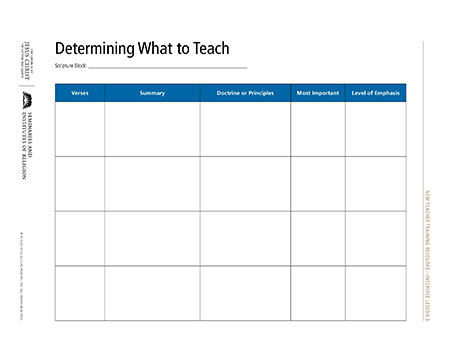
In the above trainings, it suggests that you identify the different segments of material you want to cover and then determine which depth you want to take each one during class, since rarely can you cover all your material to application (at least I can't, by the time you want to add all those cool object lessons and application simulations :)!).

The following chart is fantastic and I can see so much potential in applying it in Vanguard!  For those who have been uncomfortable "winging it" (as I seem to do), here is a great way to start and for those of us who wing it because we feel like we have to, this is a remarkably concise way to organize and direct our lesson preparation to make it more effective.

handout, Determining What to Teach
Lesson Plan Outline

Not only would mentors benefit from this but think about what would happen for our youth if they were able to take the material they were covering and weigh and apportion inspired depth with their different areas of study!

Ahhh...the possibilities.

Tuesday, January 28, 2014

Sample overview of Journeyman and Master class content for different lenses

I thought I would throw this out for anyone who wanted an idea of what it could look like.  We insert classics (people, books, poems, videos, etc.) wherever they fit.

Reminder of Goals of levels:

Core:
Questions: Why do I want to learn about this? How does this relate to me? Why do I care? What does a principle look like/feel like?  Showing evidence for the principle
-Create a love and interest of the lens of focus for that week (while reinforcing the principle)
Purposes: Inspire, Serve

Journeyman:
Questions – How can I learn to think and organize my thoughts? How do I find principles? How do I find evidence for these principles? How do I communicate those effectively?
Purposes:
Freedom to research knowledge of interest
Tools for learning in a particular lens and finding principles in what is learned and for communicating that truth

Master:
Questions – Where do I go for the best education? How do I serve others with my education? How do I present principles and their evidence in a beautiful way? Cultural Literacy (Breath), Classics (Depth)
Purposes: “Become” a classic by studying classics (not necessarily books), finding principles and evidence for them and applying those principles.
Communicating those principles in an effective and beautiful way.

 (There are specifics in the outline below, based upon books or particulars that we have chosen to focus on this year, like being able to be civil and identify fallacies as leaders.  However, you should be able to get the gist of it.)


Leadership Academy Lens
Journeyman
1) 7 Habits of Highly Effective Teens discussion
2) Simulation to reinforce concept of month and leadership abilities
3) Leadership Biography to reinforce concept of month

Master
1) Whatever Happened to Justice?
2) Application of what we have learned in this lens this week to real world
3) Civility discussion
4) Fallacies discussion

Geo-Conquest Lens
Journeyman
1) Focus on a continent (i.e. Feb-Africa and Australia):presentations
2) Map and timeline of relevant time and location
3) Focus on monthly theme/principle: biography, group of people, historical event, etc

Master
1) Geo-conquest game (the youth come with questions they have made themselves from the material that has been presented in this lens this week in the classes, divide into two teams, and they see who can answer the most correctly)
2) Services in area/Application project for monthly theme
3) How many countries can you name on the map? (optional :)...)

Eureka Lens
Journeyman
1) Dr. Posin’s Giants
2) Math game
3) Experiment based on principles

Master
1) The Math Book--brief sharing moment where the youth share one thing that happened during that time frame
2) Deeper experiments about the principle--more youth led

3) Math classic project/discussion about the principle

Imaginative Arts Lens
Journeyman
1) Artist focus--learn about the history of art (1-1 1/2 hours)
    a) picture study 60 seconds--study, think about it, notice, etc.
    b) principle to practice (i.e. use of lines, shading)
2) Spiritual Lives of Great Composers: focus on Composer or music from time period (15 minutes)
3) Art project about the principle (and inspired from the artist)
4)  Lit/Poetry project/book about the principle

Master
1) Bringing their own art about the principle and showcasing what they did
2) Specialty classes(projects and art)
3) Literature--short story, poetry, language
4) Wanting to bring together all that was discussed during the month about the monthly theme/principle

Friday, January 17, 2014

A way to expand on monthly themes

I have taken the monthly themes (life, liberty, work, role of God in society, etc.) and taken specific principles that help us understand those themes in greater depth.  For instance, for January--the month we were focusing on the Role of God and Religion in society for our theme--we chose the principle of "courage" as one of the many principles involved in preserving our religious freedoms and following our conscience.

My friend Marni brainstormed a bunch of principles/concepts that could be used within the monthly themes:

LIFE/HAPPINESS
service
agency
gratitude
personal peace
hope
standards
divine nature
example
cheerfulness
commitment *
family

LIBERTY
sacrifice
education
preserving others' liberty
agency
honoring others' agency
obedience to law
idealism*

WORK/PROPERTY
endurance
sacrifice
creativity
education
teaching
beauty
God's work
duty
first things first
resilience*
commitment*
patience

GOD/CREATOR
characteristics/attributes
sure foundation
Child of God
miracles
charity
truth (source of)
personal revelation
self-worth
faith/believe
divine potential
honoring God and others
courage*
discipleship

LEADERSHIP
service-oriented
servant
guide
influence
ministering
responsibility
example
character
conducting
honesty
conscience
good shepherd
charity
delegation
introspection
sacrifice*

SOCIETY
unity
obedience to law
home/family (influence on society)
government
security vs. freedom
trust
welfare/self-reliance
councils
accountability
justice/mercy
neighbor
honoring others' agency
integrity*
valuing people

CITIZENSHIP
obedience to law
doing the right thing
we are all enlisted
dare to stand alone
courage
responsibility
neighbor
conscience
duty
first things first
ingenuity*
*Mary's additions 
When you focus upon how that principle or concept helps us understand or appreciate a "healthy" perspective on the theme for the month it is a little easier to gather relating study material.  

Please feel free to add principles or concepts that you feel fit in the comment section below!

Thursday, June 6, 2013

Planning a new year

The following is simply a suggestion.  How you arrive at the final decision should be understood up front or specified within your bylaws.

1. Principles of 7 months:
Similar to the mentality of inspirements, we should start with principles that we want to teach.  I would sit down with those, youth and mentors, who feel that they really understand the seven monthly principles, and brainstorm how you want to focus on each month.  Someone may have a classic that they feel is very meaningful in a certain area and you many center your monthly theme on that aspect.  For example, someone may feel that "Little Britches" is important for them (or their youth, if they are an adult) to read that year.  "Little Britches" has a strong work and property theme, about the freedom, strength of character, and life lessons that can be learned through hard work and sacrifice.  Therefore, the "work" month could focus on that aspect of the principle.

I have typically sat down with a group of mentors, brainstormed meaningful books or classics that we want our youth to read, separate those classics into the seven themes (several times, books may discuss more than one theme), and then selected the books within the themes/principles that we wanted to focus on.
-you can now bring in poems and scriptures that fit this theme, to help round it out, although you don't need to have these in place before you move on

2. Look at the scripture in Doctrine and Covenants 88 about what we study:
 77 And I give unto you a commandment that you shall ateach one another the bdoctrine of the kingdom.
 78 Teach ye diligently and my agrace shall attend you, that you may be binstructed more perfectly in theory, in principle, in doctrine, in the law of the gospel, in all things that pertain unto the kingdom of God, that are expedient for you to understand;
 79 Of things both in aheaven and in the earth, and under the earth; things which have been, things which are, things which must bshortly come to pass; things which are at home, things which are abroad; the wars and the perplexities of the cnations, and the judgments which are on the land; and a dknowledge also of countries and of kingdoms—
 80 That ye may be prepared in all things when I shall send you again to amagnify the calling whereunto I have called you, and the bmission with which I have commissioned you.

Evaluate how you are going to use the lenses of art, science, and geo-conquest to bring out these points. 

Class games and techniques from the previous year should be evaluated for effectiveness and new ideas should be encouraged.  At this point, if you have lens mentors who have sound understanding of their stewardship, I would let them organize the decision making process per your group's method as outlined in your bylaws, whether by appointed committee, volunteer temporary committee, or junior mentor/lens mentor corroboration.   Then they can bring their ideas and suggestions (complete with classics, games/activities, projects) to the group or principal mentor for finalization...again, per bylaw method.

3.Come together to determine what will be studied which month. I find it easier to start with the scientific or art lens. If the person who is mentoring one of those lenses has people they would like to study, they can see if or how they fit in with the selected monthly leadership themes.  For instance, one year when we had a group of scientists that the mentor wanted to study, one of the people was Edison, famous for his work ethic.  We placed him in the month of "Work" even if he had nothing to do with the geographical theme of "Asia" that we had for that month.  Each Vanguard group can determine how effectively they want to use the lenses to coincide with the principles. The more the mentor understands the seven principles, the easier it is to make connections, and the less a student may feel like they are being fed a stream of non-related information.  Leaders make connections and bridge gaps between apparently different fields to bring things together. :)

Again, the more liberty and stewardship the mentor feels over their area, the better they are able to communicate their own passion to those they are mentoring.

4. Geography/history.  You can use this lens to help the youth focus on an area, its history and culture and understand the context of the literature, scientist, leaders, or art that they are studying in the other class(es).

Subjects may not seem to always "perfectly" complement each other, particularly in the continent of study for that month (i.e. you read a book based in Africa and study a scientist from Norway in the same month and choose to study Africa as your continent of focus). It can also be challenging to bring in leaders from the particular time period the group may be focusing on for the year, if a group chooses to organize their group in a particular time period.  However, you should keep in mind that all the material for the month should be considered lenses or angles through which the youth can study a particular truth.  The priority in choosing the continent of study should be to see, first, what the principle is, and then from there decide which continent (See post on geography and lenses.)

5. Time period.  If a group chooses to follow the pattern of time periods of other groups (like "ancient history", "medieval history," "early modern history," "later modern history"), then it is easier to facilitate multi-group events that bring out this theme (like the medieval feast two groups had last year.)  However, the needs of the particular group should take precedence.  Time periods are definitely low on the totem pole of priorities in how to structure a year.  We simply adopted this tool to help us narrow down the spectrum of focus years ago, but I have since seen how it helps to also provide more context and connections.

The brainstorming/planning for the year is best done in an open-environment, including youth and mentors that feel vested in and aware of the basic principles of Vanguard.  Synergy creates miracles, especially when including the youth mentors.  Ask them: what their needs are; how they would like to help or share their mission; how they would like to learn more about geography, science, and art; concerns, questions, and suggestions.  Specific classes and needs of youth that might not work for the whole group could be used in journeyman or master-level classes.

 With the spirit in your midst, you will be amazed at the higher truths and potential you can achieve!

Monday, June 25, 2012

Coming prepared to teach

Karen: "Here is a great quote that illustrates the importance of coming to class prepared with inspirements and sharing them. Elder Scott was talking to teachers about the importance of getting class discussion instead of just lecturing. He said:
Their decision to participate is an exercise in agency that permits the Holy Ghost to communicate a personalized message suited to their individual needs...participation will bring into their lives the direction of the spirit. -Elder Richard G. Scott"
Thanks, Karen!  Great quote!

Julie Johnson also shared the following email and link:

"This is for the mom's and dad's (and youth too if it is interesting to you).  I shared some information at the parent mentor meeting about some of the amazing things that are happening at BYU-I.  This link is a story that the deseret news did telling more of the story.  Part 1 and 2 are finished and I think part 3 will be up tomorrow.  I have loved how Mary has been so inspired and that the youth of vanguard are doing the same things that the prophet of the church counseled BYU-I to do!  Yea for inspirements!....now onto increased enrollment and online environments :)  hee hee....oh yea and more space!"
 
http://www.deseretnews.com/article/700188498/On-the-frontier-How-BYU-Idaho-is-pushing-the-boundaries-of-higher-education.html"

This is the link to part 2

Here is a excerpt from the BYU-I feedback page: 
Q: What if I am a shy student?
A: Students at BYU-Idaho “learn by faith” (D&C 88: 118). President Clark has taught: “To learn by faith, students need opportunities to take action. Some of those opportunities will come . . . in the classroom, where prepared students, exercising faith, step out beyond the light they already possess, to speak, to contribute, and to teach one another.” If you are a shy student, there will be times where you have to exercise your faith to participate and comment in class. Also realize that a Learning Model environment is a safe and supportive setting, where students “love, teach, and serve one another”. Moreover, Teach One Another activities do not all happen in large group settings. Many of these activities will occur in small discussion groups, paired teams, and online discussion formats. Make efforts to contribute in all of these teach one another settings.


Wednesday, June 20, 2012

Lens monthly structure proposed outline

What I see is this:

The first week is the leadership "lens" to set forth the topic/theme of the month.  The Leadership area was not so much a lens, as the core principle we are studying through the lenses.  Thus, the final week is merely using the arts and imaginative literature (our book discussion) lens in which to explore that principle. 

So, in other words:
Week 1: introduce the core principle to be studied
Week 2: explore it through a geographical/historical lens
Week 3: explore it through a inductive and deductive lens (math and science)
Week 4: explore it through the arts and imaginative literature lens

As in the past, we have tried to tie in the subjects to a theme to give what we study context.  Obviously, as we study people like Madame Curie, and how she exemplified "work," say, we are going to explore the wonderful things we have usually explored with our mathematicians and scientists.  So, rather than limiting our discussion, it merely confirms the connections to principles that people throughout time have embodied and inspired us with, as we explore their lives and contributions.
***********
further clarification from Karen
Karen: "I read several books including Teach the Children, Norms and Nobility and the Gateway to the Great Books Volume I. Each of these talked about different "schools of thought" that teach the students to think in different ways as they pursue truth... Here is how they were spoken of in the different books:

"Norms and Nobility:
There are 3 “schools of thought” to “form the conscience and style of each student” (with morality weaved through each one) :
1. Math and science
2. Humane letters
3. Arts and languages

"Teach the Children (ch.14):
There are four “lenses” that each child should have to properly view the world. Without these lenses the “student is handicapped in his ability to see things as they are”. Morality is the hub in which these things function to help distinguish between right and wrong
1. Math (for the ability to induce truth through logic and reasoning - inducing truth),
2. Science (for the ability to deduce truth through observation)
3. Social sciences (for the ability to see truth by widening perspective to see norms and values)
4. Arts and language (the ability to judge truth through beauty/value).

"Great Books:
There are 4 colors “representing 4 aspects of ourselves as we use words to communicate what we know, think, feel or intend”
1. Yellow - works of imagination (arts and language)
2. Blue - biographies and histories (humane letters or social studies)
3. Green - mathematics and natural sciences
4. Red - philosophy or theology (morality)

I have a visual:

A color wheel has red, yellow and blue. Each color represents a different "lens" for finding truth. Blue for humanities, yellow for the arts, and red for math and science (different than the green above for purposes of the visual). In the middle of the wheel is a white circle that represents light (the light of Christ, the Holy Ghost, morality). If we only have one color to work with - we can not see the world as clearly. Two colors help us see more clearly and we can create more color through the connections we make. All three colors will enable us see the truth all around us even more beautifully and clearly. However, without the light in the middle - we can't see anything at all.

"Tree example:
We will be weaving a principle through these lenses, but to make the idea more concrete I used a tree as an example of how these schools of thought help us see the world in a "whole" way.
Tree through leadership lens: What did Heavenly Father want us to learn from trees? How are trees used in the scriptures? How can we apply this?
Tree through science/math lens: Fibonacci numbers in different trees, circumference, age of the tree, photosynthesis, etc
Tree through history/geography: Different types of trees in different areas and how they affect the lives of the people there, how they affected the westward expansion...
Tree through arts/imaginative literature lens: Painting a tree - noticing it's colors, light, textures, beauty. Reading The Giving Tree and imagining what the world might look like through a tree's perspective.

"You can see how studying a tree through all these different lenses gives you a "whole" picture of a tree and you appreciate the truth found in it on a deeper level.

"We use a principle-based teaching approach so we take a principle and weave it through these lenses in much the same way. We make connections as we study through the different schools of thought. In addition, the youth pick "inspirements" in different learning styles and will subsequently be able to use different learning styles to see things through different lenses." (Blog post on "Vanguard Mentors"--April 2012).

Some groups are going to separate these "lenses" by week in Vanguard, to prevent the "bell-ringing interruptions"  mentioned in "Dumbing us Down" (but you can include some each week, if that format works better for you):
Week 1: Leadership Academy--principles-introducing the principle of the month which will be weaved through everything we study that month. This is the center of the wheel.

Week 2 - Face to Face With Einstein--math and science:To see the Creator’s hand in the world around us as we understand and apply the natural laws of the earth and the patterns therein; to develop the desire and ability to exercise inductive (i.e. logic) and deductive (i.e. scientific method) reasoning to find truth and to help others to do so; to expose them to great thinkers and concepts in history—to teach them to think --as well as inspire them to greatness as they study the lives of great individuals, their triumphs and struggles.

 Week 3 - Geo-conquest--history and geography: To enlarge our perspective as we view the world through the perspective of others as we study the history and culture of God’s children throughout the world. To develop the desire and ability see patterns in the past, how they relate to the present and how they may relate to the future; To develop a love for all of God’s children and a desire to serve them.

Week 4 - Imaginative Arts--arts and imaginative literature: To see the artistic view of the concept of the month as we study the imagination of man through art and literature. To develop the desire and ability to recognize truth through it’s beauty and feeling.  To desire to create new ways to share ideas to help others find truth.

Example:  I felt that the leadership class would focus on a principle that would hopefully be brought out through the other studies of the month: for instance, the historical biography for the Journeyman class for this month might be George Washington for the month of with the theme of “service-oriented leadership”, and a piece of art depicting the joy of service might be studied, or an artist that dedicated themselves to service (like Dorothea Lange’s photograph of “The Migrant Mother” from the depression), along with the art medium of photography for the subject of the journeyman class, or a painting of George Washington.  The book, "Princess Academy" could be discussed (or "The Lost Prince"...excellent!) as a way to further examine the value of service-oriented leadership.
It is more challenging to incorporate mathematicians that help mirror the theme, but it is good for the mentor to be aware of possible connection...i.e.  Thomas Edison as someone to study in the month where "the value of work" is discussed.

Tuesday, June 19, 2012

Monthly continent/Yearly time period approach

I have found that it is wonderful to make everything as much as possible fit within the monthly continent theme (and ditto for using a time period for the whole year).  It provides additional potential for connection of concepts and ideas, not to mention it gives a cultural, historical, political, and geographical background for the artists, scientists, leaders, and book studied.

We found that separating the continents as follows helped ease the discussion of different continents with different numbers of countries and cultures within its borders (order is irrelevant in itself...we always tried to make the continent work as much as possible with the people we were studying or the book we were reading, or both, on those magical months :)...):
North America
Eastern Europe
Western Europe
Eastern Asia and Oceania
Western Asia
South America
Africa
(every few years, we include something about Antarctica with Oceania)

For instance, one month we studied the concept of "Freedom," with the focus on Western Asia.  We did an art project with glittering tiles, studied math from the viewpoint of "The Alexandrians," read about Muhammad and Buddha, and read "The Homeless Bird" and "Year of Impossible Goodbyes."  It was wonderful to see overlap and connections made between the different subjects and increased relevance of projects in that context!

For the time periods, we have, in the past, just used the break down of Susan Wise Bauer in her series "Story of the World": Ancient, Medieval, Early Modern Times, and Modern Times.  However, each group should apply and use this element as they feel it helps their group, not hinders them.

These two tools, using the continents and focusing on a time period for the year, allows the students to see the development of thought and style in art, science, and history in various places of the world and time periods, and, again, gives context and more connections.  However, they should be secondary to the importance of the monthly principles and different lenses.  For instance, if the book and the scientist are from two different continents, the mentors should decide whether the scientist or the book would be better understood by looking at the geography and history of a particular continent.

Also, as geography is in itself a lens, you could choose a continent solely on how different peoples within it or historically how it has fit within the theme.  For example, on the month where you are considering the impact of religion in society, you might want to study a sampling of different religions for your geographical/historical focus.  A fabulous continent to study with that would be Asia, with its diversity of religions.

Monday, June 18, 2012

Outline of Monthly Principles

When I was first starting Vanguard, my focus was to create a leadership academy where my youth could not only have an individualized approach that incorporated leadership principles and diverse learning styles, but an academy that would deeply engrain in them the principles upon which our freedom exists here in the United States.

I believe the Constitution is an inspired document from God and that the men who created it pulled upon eternal truths to create it.

I believe that it is only as we understand these same principles that we can preserve that society.  As I have used my studies to further understand these principles, I have found that they are true principles for home and self as well as society.

These principles ask and answer the questions that have challenged societies since the dawn of time:
-what is the meaning of life?
-who is responsible for our happiness?
-what is freedom?  Do we want the responsibility of it?
-what role does God or a supreme being have  in life, family, and society?
-is man a creature of society, or is society a creature of man?  (In other words, who came first the government or man…the chicken or the egg :) ?);  subsequently, what are the foundational principles that create good government in self, family, and society?
-what kind of leaders are the ones we need to preserve that freedom?
-what is our responsibility, as a person, family member, member of mankind?
-what is property?  Who should own it? What is our responsibility once we have property?  
(see more under the heading on the home page: "Founding Principles")

BASIC OUTLINE OF MONTHLY LEADERSHIP PRINCIPLES
The first three lines (including the heading) were my organization. My friend Karen identified a similar outline in The Christian History of the Constitution of the United States of America Volume I: Christian Self-Government, by Verna M. Hall, and her outline is included in the rest of each section, drawing from that book. I have added my own principles for possible "themes within a theme" in italics, as well as a basic "why" before each section.  I personally prefer reviewing the chapters in the "5,OOO Year Leap" to understand better the concepts (they seem clearer to me in there than in the NOAH curriculum), but fully endorse the use of the Christian Heritage series if a group should choose to use those as their monthly outline.

The best way to understand these principles is to read the books suggested in that month, chapters in the 5,000 Year Leap, read the scriptures and poems that go along with it, and the follow the promptings of the Holy Ghost in the direction you feel you should go.

LIFE & PURSUIT OF HAPPINESS- 
What is man?  on the most basic level, what are we entitled to? who are we? what do we have control over?
My own answer is that we are individuals who have been placed on this earth with a right to property, life, and liberty to use those things. (I like reviewing Aristotle's first five sections in Book 1 of "Ethics" to remind myself yearly what we started out with on the most basic level.) That's it.  Nothing else.

Happiness is something we seek after.  Quality of life is relative. Our youth are growing up in a society of entitlement and I like to start the year with a good look at what their responsibility is in enjoying life and determining their own happiness.  I like to take away that sense of entitlement as much as I am able, so they will realize that life will be hard at times, but that they were born to have joy.  They need to first want that true joy, and then they will hopefully want to learn how to use the tools we will give them the rest of the year to ensure that they will have lives where they can pursue that path to joy without the interference of government or others.  

Is that not the basis for everything else that we do? That we may have eternal joy?  True Joy?

This is a capital time to also talk about mission and meaningful passions and dreams...like I said, a great way to start off the year!

5,000 Year Leap Principles: #1,6-8,22-24,28

Questions: What does it take to make a meaningful life? What is “true happiness”, and

are we entitled to it or just the pursuit of it?

Principle: America’s Heritage of Christian Character (3rd)

Teaching and Learning Key 210-224

Expanding: building character, faith, steadfastness, love, care, diligence, industry, momentary pleasure vs. true joy, sacrifice, perseverence, eternal perspective

Matt 7:24-29, 2 Tim 4:7, Phil 4:13, Acts 24:16
(My favorite book that captures this concept is "Charlie's Monument."  That book pretty much sums up this topic, with principles that take a lifetime to learn.

LIBERTY
Basically, I want them to come out of this month so angry about injustice and lack of freedom that they are willing to fight for it. Books like "The Kidnapped Prince" and "Year of Impossible Goodbyes" and "Red Scarf Girl" are good ones.

As John Locke explained many years ago:
“The end of law is not to abolish or restrain, but to preserve and enlarge freedom. For in all the states of created beings, capable of laws, where there is no law there is no freedom. For liberty is to be free from restraint and violence from others, which cannot be where there is no law; and is not, as we are told, ‘a liberty for every man to do what he lists.’ For who could be free, when every other man’s humour might domineer over him? But a liberty to dispose and order freely as he lists his person, actions, possessions, and his whole property within the allowance of those laws under which he is, and therein not to be subject to the arbitrary will of another, but freely follow his own.” (Two Treatises of Civil Government, II, 57: P>P>N>S., p.101)

5,000 Year Leap Principles #2, 8-9, 22,26

What is true freedom? Who decides that?

Principle: The Christian Form of Our Government (5th)** (see "Proper Role of Government")

Teaching and Learning 240-249

Expanding: Choice and Accountability, Courage, Individuality, Representation, Separation of Powers*, Moral Government*, Education, Integrity

Deut 1:9-18, Isaiah 33:22, Matt 22:35-40
*I feel that this more closely joins with the monthly concept of "Proper Role of Government" but can be applied here.

PROPERTY/WORK
I heard property defined as something that we work on out of nature that becomes our own.  For instance, once a man in the beginnings of the world started taking care of an apple tree that was previously unowned, it became his, growing moreso the more he worked on it.  

This concept has obvious applications on many subjects.  For instance:
-proper stewardship: we are accountable to care for those gifts/possessions that God gives us, from our talents to the resources we have around us (fun things to do this month are "Synergy of the Mind" projects that ask the students to use a given set of materials and create something with it)
-creation: we are creative beings, born to create....and there are so many fun ways to explore the joy and satisfaction that comes with creating!
Remember that you are spirit daughters of the most creative Being in the universe. Isn’t it remarkable to think that your very spirits are fashioned by an endlessly creative and eternally compassionate God? Think about it—your spirit body is a masterpiece, created with a beauty, function, and capacity beyond imagination.
But to what end were we created? We were created with the express purpose and potential of experiencing a fulness of joy. 4 Our birthright—and the purpose of our great voyage on this earth—is to seek and experience eternal happiness. One of the ways we find this is by creating things. (Uchtdorf, General Conference Oct. 2008)
 -joy of WORK: if the youth can gain appreciation of how they benefit from the "art" of work, that will bless their lives.  If they can spread that message to others, that will bless society. Only a society that works can be free. The Georgic (or agricultural) heritage of our Founding Fathers, men who worked the land they felt connected to and yearned to preserve for their own use, is getting lost in modern culture and projects that involve working and benefiting from the harvest of any labor are boundless.

5,000 Year Leap Principles #7,14,15,27

What is the value of work and ownership?

Principle: Conscience is the Most Sacred of all Property (4th)

Teaching and Learning Key: 225-239

Expanding: Stewardship/Ownership, We belong to God, taxation w/out representation, Work, integrity, honesty, value of creation, respect

consecration

Genesis 1:1; Isaiah 43:7; Ephesians 2:10; Revelations 4:11


ROLE OF GOD (I have used the phrase "Role of the Creator" in other sections of the blog to prevent over-use of His holy name.)
This month is used to explore the critical role of virtue of the people and their allegiance to God.  James Madison stated:
 To suppose that any form of government will secure liberty or happiness without any virtue in the people, is a chimerical idea. If there be sufficient virtue and intelligence in the community, it will be exercised in the selection of these men. So that we do not depend on their virtue, or put confidence in our rulers, but in the people who are to choose them.
-The Papers of James Madison. Edited by William T. Hutchinson et al. Chicago and London: University of Chicago Press, 1962--77 (vols. 1--10); Charlottesville: University Press of Virginia, 1977--(vols. 11--).)
Cicero referred to it as "natural law" (see 5,000 Year Leap), a basic level of decency that must be accepted in society in order for it to function.  Virtues like honesty, decency, charity are critically connected to the success in our "experiment with liberty."  

You can use this month to discuss: the importance of these virtues (or what society is like without it, like in "The Boy in the Striped Pyjamas"); the 10 Commandments, following inspiration, seeking God's will (which is closely tied with the previous concept); the necessity of allegiance to God; the many faiths in the world and their various pursuits to worship God in their own way (diversity!); the importance of finding God and trusting Him ("I am David"); the right to religion; why have prayer in schools...or even, why we are "one nation, under God" to begin with and the religious views of the founding fathers.

If the youth don't have a basic dependence upon God and trust in Him, nothing else matters.

5,000 Year Leap Principles #4,5

What is the role of "natural law" and God in society?

Principle: God’s Principle of Individuality (1st)

Teaching and Learning Key:141-183

Expanding: Oneness, Indivisibility, Independence, Uniqueness, Godhead, Inspiration, Faith, Virtue, Respect, Diversity, Integrity

Genesis 1, John 1:3, 1 Corinthians 12:4-11


LEADERSHIP
Now that we have an understanding of the basic rights and needs in society, we start looking at who we want to lead it.  (This and the next concept could easily be interchanged in order.)  To understand this concept, it is best to look at the life of George Washington, read the 5,000 Year Leap principles below.

These youth will lead in some capacity, whether it is in the home, community, nation...or even self.  It is critical that they develop this "core" trait of leadership, this quality of service and thinking above others over self.

This is a great month for them to study real people and those in fiction to expose them to great souls like Ghandi, Mother Theresa, George Washington, Jean Valjean, Loristan ("The Lost Prince"), and others and see the pain and joy that comes from serving others before self.  Not only must they see the need for that quality in themselves as successful parents and leaders, but they must seek to recognize it in those they desire to put into office.  They also will hopefully apply it in the current leadership positions they have in Vanguard, in their communities, and in church.

5,000 Year Leap Principles #3,20

Ego-centric versus service-oriented?

Principle: How the Seed of Local Self-Government is Planted (6th)

Teaching and Learning Key 250-261

Expanding: Liberty under law, Charity, Change of Heart, Service

Deut 10:12-14, Isaiah 9:6, Luke 9:6; Moroni 7:48

PROPER ROLE OF GOVERNMENT- 
Now that we have determined what kind of people, leaders and principles a society must have to be productive, good, and free, we need to look at what kind of government helps to maintain this kind of society.  A good look at the origins of society can be found in the first book of Aristotle's Politics...particularly the first few sections. From there, the dedicated student of this topic should read Benson's Proper Role of Government article or watch/listen to the recording. This is one of the more challenging subjects we study, as it is the application of true principles in an imperfect model: government.  I will take a little longer to flesh out this idea and its background.

In Skousen's book, "Making of America" he recounts that at the time of the Founders, governments had only ever arisen that were structured to exploit the people, reduce them to poverty, or marshall their youth into war. "No existing governnment was designed to provide its people wiht freedom, prosperity, and peace.  Therefore, the Founders sat down to invent one...more like a restoration of what Jefferson called 'the ancient principles.'"
The Founders' goal was to revive the ancient principles which would allow the sunsine side of human nature to enjoy virtually unlimited freedom, whil setting up appropriate safeguards to preven the doleful shadow of human passion, greed, and lust for power from spreading across the globe. (Skousen?)
This is a great month for simulations for the youth to put into practice what they have learned, simulations where they create government, groups or organizations based upon the principles they have learned thus far.  Games like Nomics, movies like "A More Perfect Union," and even youth elections for the next year could be incorporated at this time.

I feel the only way to understand this subject is to study it.  What is it that makes good government: an abundance of rules and regulations? (see "Animal Farm") Virtue of the people? People who want to ensure security? (see "The Giver")...
Others that may help lend insight to this important question about "what and how much is good government?" are:
 Dream Giver

The Chosen
The Hunger Games
Seven Miracles
Seven Tipping Points 
The Witch of Blackbird Pond 
The Alliance, by Gerald Lund (excellent and clean!)
St. Joan by Twain

Antigone (Les Mis complement the questions brought up in Antigone)
 
Unfortunately, most of the books are about governments gone bad and what not to do. Basically, when the youth come out of Vanguard, I want them to recognize signs of bad government and have some ideas of what government should be. :)  Government is a necessary evil, ideally set-up to secure the basic rights of man. As one of the founding fathers said, if men were angels, we would need no government :). 

And, it is not until the youth feel passionate about their rights and defending them that they will even care about what their government looks like, which is why I put this later in the year for my own groups.

Other principles you can explore are included below, all of which are excellent virtues/principles for a government to have. I included "Self-discipline" due to the following quote from "Proper Role of Government":
“That the sole object and only legitimate end of government is to protect the citizen in the enjoyment of life, liberty, and property, and when the government assumes other functions it is usurpation and oppression.” (Art. 1, Sec. 35)
Actually, having written all this and researched to find sources and quotes, I think the best way to understand this topic is to read the article "Proper Role of Government" referenced above :).  It is the shortest, most effective means to show why this topic is so important, as well as to give many examples and ideas of how to teach it, what to focus on, and how to apply it or relate to it as a mentor.

5,000 Year Leap Principles #12,13,16-18,19,21

Security versus freedom: where to draw the line in society?  When is "less" actually "more"?

Principle: The Christian Principle of American Political Union (7th)**

Teaching and Learning 262-268

Expanding: Unity, Fellowship, Zion, Self-discipline, Representation, Separation of Powers, Moral Government

1 Corinthians 1:10, Psalms 133:1, Eph 4:1-3

**These could be switched.
Example:
Antigone and Les Miserables: these are a remarkable combination when looking at the role of justice vs. mercy in government...basing it around Antigone.  In fact, in the 3rd book of the Eragon series is an example of this issue: when a leader of part of the army led his troops against orders and ended up saving many people.  However, technically, he had disobeyed direct orders, and was publicly flogged for his disobedience. You may also tie in "Gifted Hands" with the scene of Ben Carson operating on the patient who came into the ER, near death and with no person present authorized to operate or to give him authority to operate...and him doing it anyway.  Good, hard questions!! (Like Nephi slaying Laban, the Anti-Nephi-Lehi's laying down weapons of war and being slaughters, Moroni/Joshua leading troops into God-sanctioned battle.)


CITIZENSHIP
I feel like this is the "so what do we do now?" month :).  We have taught them all these great things; now it is their turn to try and apply them in their lives.  Books and people that they can really relate to are particularly powerful this month, as they are at the end and ready to go and do something with their new knowledge.

Let me know if you need more on this. :)  It's a great way to end the year! 

5,000 Year Leap Principles #10,11

Who is responsible to determine what is right, and how can they do what needs to be

done?

Principle: The Christian Principle of Self Government (2nd)

Teaching and Learning Key: 184-209

Expanding: Delegating, Thrift, Industry, Self-Reliance, Responsibility

Proverbs 16:32, 1 Timothy 3:5

I think the monthly theme categories are comprehensive enough in nature that any leadership principle that I have come across can fit into one of those categories.  I believe if mentors look at a principle they are interested in focusing on for one of the months in the year, I think they could find one of the seven general principles that it would fit under.

For instance, in the leadership theme of property, we have covered the concept of the value of work (Little Britches), the healing nature of being in the outdoors and working outdoors (The Miracle of Maple Hill), and joy and lessons learned in the act of creation (Becoming Isaac and The Single Shard).  In the month about "worshiping God" we have studied the diversity of religions--with the underlying need for all to find God (and what life is like in a godless society--"Boy in the Striped Pajamas"), God's voice in our lives as we seek to find personal mission ("The Alchemist"), and the strength that God can be in the lives of individuals to make good decisions that benefit society ("I am David" and "The Hiding Place").

It has been amazing to me how all the articles, books, and etc. that I come across that touch and inspire me with leadership, agency, stewardship, etc. principles have been easily placed in one or more of the seven categories.

While others may feel this is too narrow a sphere to study, I feel that this is the time to resurrect an education of these principles, of this dialogue, in order to preserve our freedom to study other things.  As John Adams wrote to his wife:
The science of government it is my duty to study, more than all other sciences; the arts of legislation and administration and negotiation ought to take the place of, indeed exclude, in a manner, all other arts. I must study politics and war, that our sons may have liberty to study mathematics and philosophy. Our sons ought to study mathematics and philosophy, geography, natural history and naval architecture, navigation, commerce and agriculture in order to give their children a right to study painting, poetry, music, architecture, statuary, tapestry and porcelain. --Letter to Abigail Adams (12 May 1780)
Thursday, March 1, 2012

Mentoring with flair

When working with youth,  (or in any teaching environment) there are things that I believe are important to being successful:
1) doing what you love and being passionate about it-
“A leader recognizes that his attitude determines his altitude.  He knows full well that nothing is as contagious as enthusiasm, unless it is a lack of enthusiasm.  He carries others to accomplishment through the sheer strength of his overwhelming desire to bring success to his assignment.  The leader who gets the job done is one who inspires confidence, who motivates action, and who generates enthusiasm.  You will ever recognize his work—for it will be well done.”   --Thomas S. Monson, “Be Your Best Self” p. 118

2) loving the youth-
Joseph Smith: "When persons manifest the least kindness and love to me, O what power it has over my mind, while the opposite course has a tendency to harrow up all the harsh feelings and depress the human mind." (Daughters of My Kingdom, pg 23)

3) don't be afraid to be flamboyant (it can be a learned behavior to be silly again :)...)-I listened to a talk by Andrew Groft from the 2007 Forum, where he said that a key to great mentoring is to not be afraid to be human in front of the youth, make mistakes, and even do something crazy every once in a while.  It helps let the youth's guard down, and makes you more approachable and real to them.  I had learned very early how to keep myself guarded and controlled, so when I first heard this, I was skeptical..."Surely, I am not one of those type of teachers.  I just couldn't do that!"  Yet, I tried it.  I came out, draped in silks during a class on Pythagoras, that famous flamboyant mathematician.  I cannot tell you how foolish I felt!  However, you could see the youth, first shocked, then amused, then relaxed...all because I had a few moments of being "weird" in front of them.  
I have seen since then how much easier it is for them to connect with me, knowing that I will honestly admit my mistakes in front of them, not pretend to know more than I do (most of the time :)...), and be a little silly every once in a while.

4) be with them--I cannot over-emphasize the importance of this in being a meaningful mentor.  Go to the activities outside of class with them.  Get down on the floor and play the games with them.  Come with your own inspirements.  Stand around and talk to them during lunch.  Avoid the adult tendency to gravitate to other adults.  Sit by them, learn with them, share with them, play with them,...be near them, and it will be easier for them to come to you, connect with you, and trust you.  Not only that, it is in those small, unplanned moments that you can see little glimpses into their souls and personalities that are difficult to gain in class time.
Of course, you must moderate this interaction with other responsibilities, but make the most of the time you are with them to be with them.

Friday, February 24, 2012

Attention Span considerations

Much is said about catering to the limited attention span of youth.  However, how powerful would it be if we took measures to help expand the attention span of youth?  Consider the following incredible article on this subject by Oliver DeMille:

http://www.tjedonline.com/free-article.php?id=166

The COG of Journeyman mentoring

Journeyman classes are classes that address what I consider the second phase of scholarship--gaining more complete understanding by taking it to a deeper level of relating it to ourselves, making connections with other truths, or studying it more in depth.

It is an exciting level of scholarship (related to the "project-scholar" phase of TJEd scholar phase), in which the youth has decided they want to take their knowledge of something to a different level and are willing to do what the mentor is prescribing to get to that deeper level.

It requires considerably more on the part of the mentor as they need to prepare more to be ready for the deeper level of preparation brought to the table by the youth, but the feast is sweet!

There are three components I believe, to keeping Journeyman level scholarship running smoothly:
C: Commitment or Contract: There needs to be integrity on the part of the youth and the parent in making sure that they, first, know what they are committing to by being in the class, and, second, honor that commitment. I brought up how when Zoram took an oath with Nephi and his brothers that he would follow him, "their fears did cease concerning them." I thought it would be a great opportunity to teach our youth the importance of what pledging our word means.

The mentor for the class follows up to some degree, posting monthly (or so) updates of what they have recorded for their progress through the class, but their main role is to individually guide where needed and teach the material and provide the structure.

There is an incredible mormon message on honesty at the following link:
http://www.lds.org/pages/mormon-messages?lang=eng#honesty

I like how it said that ultimately, when we honor our commitments at school we are becoming all we can be. That is the principle, I feel, not a "catch-em-in-the-act" mentality. :) The journeyman classes are a gift offered by the mentor to guide a youth to a deeper level of experience in a given area. By trusting and following that mentor in that path (under the direction of the Holy Ghost and parental guidance, of course), the student will gain from the mentor. Ultimately, not doing what is agreed to is going to impede the youth. I hope we can teach this as a positive thing :

I was going to use the word "covenant" to add more meaning to this contract between mentor and student, but decided not to, since in these modern times it is less used in a secular sense and more and more often in a spiritual sense.

However, the following definition from the LDS Bible Dictionary bears consideration as we consider what it means to "give our word":

"Covenant. Sometimes denotes an agreement between persons (1 Sam. 23:18) or nations (1 Sam. 11:1); more often between God and man; but in this latter case it is important to notice that the two parties to the agreement do not stand in the relation of independent and equal contractors. God in his good pleasure fixes the terms, which man accepts. The same word is sometimes rendered “testament.”

The gospel is so arranged that principles and ordinances are received by covenant placing the recipient under strong obligation and responsibility to honor the commitment."  

There is a great article on this aspect of holding youth accountable as a part of leadership in the Deseret News leadership column by Timothy Clark titled: "The skill and will of accountability". (Deseret News, Mon. April 9, 2012) 

O: Observe. Going hand in hand with the excellent talk discussed at the mentor meeting (http://www.lds.org/liahona/2006/12/quick-to-observe?lang=eng&query=observe), we want to observe in order to be able to love and serve better: observe their strengths, observe where we can help them, observe their individual needs in an area and help them do that. 

G: Guide, which is synonymous with "mentoring" in my mind. Incorporate the 5 environments: lecture, tutorial (smaller groups), coaching, group discussion. There is a great link at the following:

At this level of education, you can really incorporate these well as the youth are eager and willing to jump in.

Monday, February 20, 2012

Accountability in class

 There is a fabulous quote/Mormon message featuring a talk about "honesty" by Pres. Faust at: http://www.lds.org/media-library/video/mormon-messages?lang=eng#2011-05-011-honesty
(the actual talk can be found at: http://www.lds.org/ensign/1996/11/honesty-a-moral-compass?lang=eng&query=faust+honesty)

I was struck by the following quote he shared and thought it related very well to Vanguard. 

"In reality, we are only in competition with ourselves. Others can challenge and motivate us, but we must reach down deep into our souls and call forth our God-given intelligence and capabilities. We cannot do this when we depend on the efforts of someone else."

It reminded me of the beginning of the year, when the mentors told the youth and parents that there was an expectation that everyone come with inspirements each week for each class .  The teachers take time to come with material prepared, and it is the responsibility of the student to come prepared.  Some parents were concerned when I said this, saying something to the effect, "if you are going to expect that, you better follow through...".

I believe that there are two areas of following through:
-mentors: the mentors responsibility is to inspire, be clear, and have some sort of visible accountability (check off a list, verbal accountability in class, etc.)
-parents: parent mentor meetings
-students: accurately report to mentors and parents about preparation; make sure they come prepared because they are choosing to be in the class.

I thought the following quote was particularly relevant:
We have the agency to make choices, but ultimately we will be accountable for each choice we make. We may deceive others, but there is One we will never deceive.
The students must be accountable for their educationIt can be learned step by step, and line upon line. This concept may effectively be reinforced supported through devotionals, class, and home teaching.  Unless they are taught and inspired to own  their education by coming prepared each week to class, Vanguard becomes a merely social environment.  The parents and students need to realize that coming prepared each week is the price they pay to be in Vanguard, and their integrity or lack thereof in doing this will not only cheat others of the chance to learn from them, but ultimately harm themselves.

Sunday, February 19, 2012

Suggested outline for Core class

Suggested outline of Weekly schedule for CORE classes
Opening ceremony & Announcements
Devotional & Memorization
Classes and activities alternated to blend physical activity with mental learning
Appropriately placed lunch break (suggested 15 minutes)
Closing prayer
Recommended 3-4 hours for this segment, depending upon which activities are included
NOTE: Mondays and Fridays have not worked so well :).

Definition of some of the activities during class time:
Opening Ceremony (youth-led): Welcome, Thought, Pledge, Mission Statement, Prayer, Time for Ah-hah's
"Ah-hahs!": A time where youth can share connections or epiphanies from previous studies--should be limited to brief sharings, not prepared presentations :).
Devotional: Weekly inspiring message from youth/mentor (opt. used to reinforce monthly concept)
Memorization: Poem and Scripture for month.
Spotlights: (can be done by VP), spotlights the youth at least once in the year (during "Announcements")