"Immediate necessity makes many things convenient, which if continued would grow into oppressions. Expedience and right are different things."--Jefferson
Showing posts with label mentoring. Show all posts

Friday, September 9, 2016

Fantastic Lesson Plan Resource for Mentors

Questions about mentor training?  Here you go!

I am training to be a Seminary teacher for my church and in the training, they outline how to make a lesson plan with the purpose of teaching principles so that the youth may apply them. It involved the "crust" skills (context and content) but puts them in their appropriate place as the overall goal of teaching in Vanguard is to change "cores" and strengthen them by helping the students seek for, recognize and identify true principles in all they learn in the world around them.

I have had many people ask me, "How do I seek for principles and teach them?"
This is the way.
Check out the learning videos: New Teacher Training Resource 
I would focus on lesson #9.  The lessons can be time consuming if done in their entirety but you can skim over them to get the gist.  In fact, if you review the lessons #5-8, you will see that they have taken the three step approach of knowledge, understand and intelligence and expanded it a bit, but it is the same basic idea, incorporating the core and crust concepts as well (without identifying them as such :).)
  • Understand the context and content-crust
  • Identify important doctrine and principles-knowledge-core/crust
  • Understand the doctrine and principles-understanding-core
  • Feel the truth and importance of those doctrines and principles-deeper understanding-core
  • Apply the truths in their lives-intelligence-core
 I love this!
In the above trainings, it suggests that you identify the different segments of material you want to cover and then determine which depth you want to take each one during class, since rarely can you cover all your material to application (at least I can't, by the time you want to add all those cool object lessons and application simulations :)!).

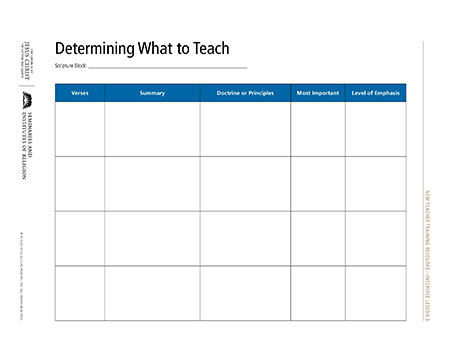
The following chart is fantastic and I can see so much potential in applying it in Vanguard!  For those who have been uncomfortable "winging it" (as I seem to do), here is a great way to start and for those of us who wing it because we feel like we have to, this is a remarkably concise way to organize and direct our lesson preparation to make it more effective.

handout, Determining What to Teach
Lesson Plan Outline

Not only would mentors benefit from this but think about what would happen for our youth if they were able to take the material they were covering and weigh and apportion inspired depth with their different areas of study!

Ahhh...the possibilities.

Tuesday, December 31, 2013

As we start a new year of Vanguard...

What a breath of fresh air.

Each new year should begin with a "back to basics" reading.

Here is one I recommend for every mentor and parent in Vanguard: Learning to Love Learning

It has gems like: "learning to love learning is central to the Gospel of Christ."
...and one of my personal favorites: "One of the meanings of 'intelligence' is the application of the knowledge we obtain for righteous purposes."

It reminds me of Karen's recent post about their December Mentor Meeting (a very thought-provoking read), in which she wrote:
"Some purposes of Vanguard:
-To give youth a place where they can discuss and present the great ideas/truths they are finding in their studies.
-To offer guidance in what to study and discuss
-Mentor feedback in addition to parent mentors
-To inspire a quest for truth (true principles)
-To motivate skill improvement
Vanguard does not try to: Teach them all they need to know to cover everything in a subject"


It is possible and powerful to study, learn, and act in a God-directed way.  We must not only do it ourselves, but do all we can to inspire our youth to do the same :)!  Love learning!

Learning to Love Learning

David A. Bednar
Understanding who we are, where we came from, and why we are on the earth places upon each of us a great responsibility both to learn how to learn and to learn to love learning.--Elder Bednar
Learning to love learning is central to the gospel of Jesus Christ, is vital to ourongoing spiritual and personal development, and is an absolute necessity in the world in which we do now and will yet live, serve, and work. I want to briefly discuss the importance of learning to love learning in three aspects of our lives.

1. Learning to Love Learning Is Central to the Gospel of Jesus Christ

The overarching purpose of Heavenly Father’s great plan of happiness is to provide His spirit children with opportunities to learn. The Atonement of Jesus Christ and the agency afforded to all of the Father’s children through the Redeemer’s infinite and eternal sacrifice are divinely designed to facilitate our learning. The Savior said, “Learn of me, and listen to my words; walk in the meekness of my Spirit, and you shall have peace in me” (D&C 19:23).
We are assisted in learning of and listening to the words of Christ by the Holy Ghost, even the third member of the Godhead. The Holy Ghost reveals and witnesses the truth of all things and brings all things to our remembrance (see John 14:26, 16:13; Moroni 10:5; D&C 39:6). The Holy Ghost is the teacher who kindles within us an abiding love of and for learning.
We repeatedly are admonished in the revelations to ask in faith when we lack knowledge (see James 1:5–6), to “seek learning, even by study and also by faith” (D&C 88:118), and to inquire of God that we might receive instruction from His Spirit (see D&C 6:14) and “know mysteries which are great and marvelous” (D&C 6:11). The restored Church of Jesus Christ exists today to help individuals and families learn about and receive the blessings of the Savior’s gospel.
A hierarchy of importance exists among the things you and I can learn. Indeed, all learning is not equally important. The Apostle Paul taught this truth in his second epistle to Timothy as he warned that in the latter days many people would be “ever learning, and never able to come to the knowledge of the truth” (2 Timothy 3:7).
Some facts are helpful or interesting to know. Some knowledge is useful to learn and apply. But gospel truths are essential for us to understand and live if we are to become what our Heavenly Father yearns for us to become. The type of learning I am attempting to describe is not merely the accumulation of data and facts and frameworks; rather, it is acquiring and applying knowledge for righteousness.
The revelations teach us that “the glory of God is intelligence” (D&C 93:36). We typically may think the word intelligence in this scripture denotes innate cognitive ability or a particular gift for academic work. In this verse, however, one of the meanings of intelligence is the application of the knowledge we obtain for righteous purposes. As President David O. McKay (1873–1970) taught, the learning “for which the Church stands—is the application of knowledge to the development of a noble and Godlike character.” 1
You and I are here on the earth to prepare for eternity, to learn how to learn, to learn things that are temporally important and eternally essential, and to assist others in learning wisdom and truth (see D&C 97:1). Understanding who we are, where we came from, and why we are on the earth places upon each of us a great responsibility both to learn how to learn and to learn to love learning.

2. Learning to Love Learning Is Vital to Our Ongoing Spiritual and Personal Development

President Brigham Young (1801–1877) was a learner. Although President Young had only 11 days of formal schooling, he understood the need for learning both the wisdom of God and the things of the world. He was a furniture maker, a missionary, a colonizer, a governor, and the Lord’s prophet.
I marvel at both the way Brigham Young learned and how much he learned. He never ceased learning from the revelations of the Lord, from the scriptures, and from good books. Perhaps President Young was such a consummate learner precisely because he was not constrained unduly by the arbitrary boundaries so often imposed through the structures and processes of formal education. He clearly learned to love learning. He clearly learned how to learn. He ultimately became a powerful disciple and teacher precisely because he first was an effective learner.
President Young repeatedly taught that “the object of [our mortal] existence is to learn.” 2 The following statements by President Young emphasize this truth:
  • “The religion embraced by the Latter-day Saints, if only slightly understood, prompts them to search diligently after knowledge. There is no other people in existence more eager to see, hear, learn, and understand truth.” 3
  • “Put forth your ability to learn as fast as you can, and gather all the strength of mind and principle of faith you possibly can, and then distribute your knowledge to the people.” 4
  • “This work is a progressive work, this doctrine that is taught the Latter-day Saints in its nature is exalting, increasing, expanding and extending broader and broader until we can know as we are known, see as we are seen.” 5
  • “We are in the school [of mortality] and keep learning, and we do not expect to cease learning while we live on earth; and when we pass through the veil, we expect still to continue to learn and increase our fund of information. That may appear a strange idea to some; but it is for the plain and simple reason that we are not capacitated to receive all knowledge at once. We must therefore receive a little here and a little there.” 6
  • “We might ask, when shall we cease to learn? I will give you my opinion about it: never, never.” 7
Brigham Young’s acceptance of and conversion to the gospel of Jesus Christ fueled his unceasing curiosity and love of learning. The ongoing spiritual and personal development evidenced in his life is a worthy example for you and for me.

3. Learning to Love Learning Is an Absolute Necessity in the World in Which We Do Now and Will Yet Live, Serve, and Work

On the landmark sign located at the entrance to Brigham Young University, the following motto is found: “Enter to learn; go forth to serve.” This expression certainly does not imply that everything necessary for a lifetime of meaningful service can or will be obtained during a few short years of higher education. Rather, the spirit of this statement is that students come to receive foundational instruction about learning how to learn and learning to love learning. Furthermore, students’ desires and capacities to serve are not “put on hold” during their university years of intellectual exploration and development.
May I respectfully suggest an addition to this well-known motto that is too long to put on the sign but important for us to remember regardless of which university or college we attend: “Enter to learn to love learning and serving; go forth to continue learning and serving.”
Academic assignments, test scores, and a cumulative GPA do not produce a final and polished product. Rather, students have only started to put in place a foundation of learning upon which they can build forever. Much of the data and knowledge obtained through a specific major or program of study may rapidly become outdated and obsolete. The particular topics investigated and learned are not nearly as important as what has been learned about learning. As we press forward in life—spiritually, interpersonally, and professionally—no book of answers is readily available with guidelines and solutions to the great challenges of life. All we have is our capacity to learn and our love of and for learning.
I believe a basic test exists of our capacity to learn and of the measure of our love of learning. Here is the test: When you and I do not know what to do or how to proceed to achieve a particular outcome—when we are confronted with a problem that has no clear answer and no prescribed pattern for resolution—how do we learn what to do?
This was precisely the situation in which Nephi found himself as he was commanded to build a ship. “And it came to pass that the Lord spake unto me, saying: Thou shalt construct a ship, after the manner which I shall show thee, that I may carry thy people across these waters” (1 Nephi 17:8).
Nephi was not a sailor. He had been reared in Jerusalem, an inland city, rather than along the borders of the Mediterranean Sea. It seems unlikely that he knew much about or had experience with the tools and skills necessary to build a ship. He may not have ever previously seen an oceangoing vessel. In essence, then, Nephi was commanded and instructed to build something he had never built before in order to go someplace he had never been before.
I doubt that any of us will be commanded to build a ship as was Nephi, but each of us will have our spiritual and learning capabilities tested over and over again. The ever-accelerating rate of change in our modern world will force us into uncharted territory and demanding circumstances.
For example, the U.S. Department of Labor estimates that today’s college graduates will have between 10 and 14 different jobs by the time they are 38 years old. And the necessary skills to perform successfully in each job assignment will constantly change and evolve.
For much of my career as a professor, there was no Internet, no Google, no Wikipedia, no YouTube, and no telepresence. The Internet only began to be widely used by the general public in the mid-1990s. Prior to that time, no courses were taught about and no majors were offered in Internet-related subjects. I remember teaching myself HTML and experimenting with ways student learning could be enhanced through this new and emerging technology. In contrast, most students today have never known and cannot imagine a world without the Internet and its associated technologies. Can we even begin to imagine how much things will continue to change during the next 15 years?
Because vast amounts of information are so readily available and sophisticated technologies make possible widespread and even global collaboration, we may be prone to put our “trust in the arm of flesh” (2 Nephi 4:34; see also 28:31) as we grapple with complex challenges and problems. We perhaps might be inclined to rely primarily upon our individual and collective capacity to reason, to innovate, to plan, and to execute. Certainly we must use our God-given abilities to the fullest, employ our best efforts, and exercise appropriate judgment as we encounter the opportunities of life. But our mortal best is never enough.
President Young testified that we are never left alone or on our own:
“My knowledge is, if you will follow the teachings of Jesus Christ and his Apostles, as recorded in the New Testament, every man and woman will be put in possession of the Holy Ghost. … They will know things that are, that will be, and that have been. They will understand things in heaven, things on the earth, and things under the earth, things of time, and things of eternity, according to their several callings and capacities.” 8
Learning to love learning equips us for an ever- changing and unpredictable future. Knowing how to learn prepares us to discern and act upon opportunities that others may not readily recognize. I am confident we will pass the test of learning what to do when we do not know what to do or how to proceed.
I witness the living reality of God the Eternal Father; of our Savior and Redeemer, even the Lord Jesus Christ; and of the Holy Ghost. I also declare my witness that the gospel of Jesus Christ has been restored to the earth in these latter days.

Tuesday, June 25, 2013

Secure, not Stressed

Recent article by Oliver DeMille...inspiring as always.

Secure, Not Stressed–Applied to Our Children and Youth: The Weekly Mentor

By Oliver DeMille
During the last decade a number of books on education have promoted the need to put freedom back into our schools.
I have long called this the Thomas Jefferson Education (TJEd) approach to learning, and I have enjoyed the many books and research that increasingly prove the common-sensical reality that students learn better when they are free to be self-directed and follow their passions.
Indeed, in a free model most students learn better in all subjects, not just in their chosen areas of focus.
Peter Gray’s book Free to Learn is an excellent addition to this genre of books on restoring freedom in education.
Gray clearly states:
“Children are biologically predisposed to take charge of their own education.
“When they are provided with the freedom and means to pursue their own interests, in safe settings, they bloom and develop along diverse and unpredictable paths, and they acquire the skills and confidence required to meet life’s challenges.
“In such an environment, children ask for any help they may need from adults. There is no need for forced lessons, lectures, assignments, tests, grades, segregation by age into classrooms, or any of the other trappings of our standard, compulsory system of schooling.
“All of these, in fact, interfere with the children’s natural way of learning.”
So why did we create schools that so directly “interfere with the children’s natural way of learning”?
Gray shows that in tribal cultures the focus of childhood was playing and learning knowledge, skills, and how to live self-sufficiently and honorably.
When the agrarian revolution increased the need for child labor on farms, the values of school turned to toil, competition and status.
While Gray’s view of this is perhaps a bit idyllic, the reality is that modern schools are less concerned with student knowledge, skills, honor or abilities than with the universal goal of job training.
Certainly job training has an important place in advanced society, but Gray is focused on the education of children, and in fact the toll on children in our modern job-obsessed schools is very high.
For example, Gray cites one study, among others, that compares the levels of anxiety and stress of youth ages 14-16 in 1948 versus 1989:
Question:                                                      1948               1989
“I wake up fresh and rested most mornings.”      74.6%            31.3%
“I work under a great deal of tension.”                 16.2%             41.6%
“Life is a strain for me much of the time.”             9.5%              35.0%
“I am afraid of losing my mind.”                             4.1%              23.4%

Why are we raising a generation of children and youth who are “stressed, not secure?”
Gray’s answer, based on a great deal of research which he outlines in the book, is that we have turned learning into a chore, a task, a labor, rather than the natural result of curiosity, interest, passion to learn, and self-driven seeking of knowledge and skills.
In short, we’ve taken too much play out of childhood and too much freedom out of learning.
The results are a major decline of American education in the last four decades.
The solution is to put freedom back into education.
Interestingly, Gray suggests that for many of the classrooms, schools, homes and teachers that have found a way to successfully overcome these problems and achieve much better educational results, one of the key ingredients is “free age-mixing.”
Where students are allowed to freely mix with other students of various ages, without grade levels, the capacity of individuals to effectively self-educate is much higher.
As for the impact on college and career success, students from free educational models excel.
This is a good book, and a must read for those who really care about education.
I don’t agree with everything the author teaches, but I learned something important on almost every page.
Whether or not you read Free to Learn, all of us who have children or work in education need to do more to promote the importance of increased freedom in education.
Gray is a particular fan of “unschooling,” a type of homeschooling and private schooling where parents and teachers set an example of great education, create an environment of excellent learning, and let the kids become self-learners.
While this may not be the ideal learning style for every student, it is the best model for a lot of them–and for nearly every young person under age 12.
If you disagree with this conclusion, you simply must read Gray’s book.
The research is impeccable.
If you do agree, the book can help you get to work setting a better example for any students in your life.
Another important book about freedom (and the lack of it) in modern education is Wounded by School by Kirsten Olson.
It outlines the normal ways in which modern education hurts most children, shows the history of why schools adopt such harmful policies, and suggests real solutions.
For example, Olson writes:
“Many theorists suggest that the purpose of schools is to mold and shape individual self-concept so that pupils will accept a particular place in society…”
Is this really what you want for your children?
On a larger scale, what is the impact on freedom of raising a generation of youth to “accept a particular place in society”?
This is a class system, pure and simple.
Olson points out that “Schools are deliberately designed to sort and track” students into order to promote the class system.
In my book A Thomas Jefferson Education I called this a conveyor belt approach to learning.
Olson also suggests that among the key ways modern schools wound students are things like the following:

I felt sick in school.
I’m in the middle.
I must comply.
I can’t measure up.
I am better than those below me.
I must impress my superiors.
What I want isn’t as important as what my betters want.
Creativity must be secret—my focus must be conformity.
Learning isn’t fun.

And for parents: “I feel helpless about saving my child,” and “The experts know what my kids need more than I do.”
Olson’s solutions center around bringing freedom back into schooling.
Indeed, this is the focus of a lot of cutting-edge books and research on education.
Above all, we need to be clear about one thing: Freedom works.
It does.
Freedom is the best choice in society and also in education.
If you are a parent or teacher, you have more power than you know.
Why are we raising a generation of children and youth who are “stressed, not secure?”
Gray’s answer, based on a great deal of research which he outlines in the book, is that we have turned learning into a chore, a task, a labor, rather than the natural result of curiosity, interest, passion to learn, and self-driven seeking of knowledge and skills.
In short, we’ve taken too much play out of childhood and too much freedom out of learning.
The results are a major decline of American education in the last four decades.
The solution is to put freedom back into education.
Interestingly, Gray suggests that for many of the classrooms, schools, homes and teachers that have found a way to successfully overcome these problems and achieve much better educational results, one of the key ingredients is “free age-mixing.”
Where students are allowed to freely mix with other students of various ages, without grade levels, the capacity of individuals to effectively self-educate is much higher.
As for the impact on college and career success, students from free educational models excel.
This is a good book, and a must read for those who really care about education.
I don’t agree with everything the author teaches, but I learned something important on almost every page.
Whether or not you read Free to Learn, all of us who have children or work in education need to do more to promote the importance of increased freedom in education.
Gray is a particular fan of “unschooling,” a type of homeschooling and private schooling where parents and teachers set an example of great education, create an environment of excellent learning, and let the kids become self-learners.
While this may not be the ideal learning style for every student, it is the best model for a lot of them–and for nearly every young person under age 12.
If you disagree with this conclusion, you simply must read Gray’s book.
The research is impeccable.
If you do agree, the book can help you get to work setting a better example for any students in your life.
Another important book about freedom (and the lack of it) in modern education is Wounded by School by Kirsten Olson.
It outlines the normal ways in which modern education hurts most children, shows the history of why schools adopt such harmful policies, and suggests real solutions.
For example, Olson writes:
“Many theorists suggest that the purpose of schools is to mold and shape individual self-concept so that pupils will accept a particular place in society…”
Is this really what you want for your children?
On a larger scale, what is the impact on freedom of raising a generation of youth to “accept a particular place in society”?
This is a class system, pure and simple.
Olson points out that “Schools are deliberately designed to sort and track” students into order to promote the class system.
In my book A Thomas Jefferson Education I called this a conveyor belt approach to learning.
Olson also suggests that among the key ways modern schools wound students are things like the following:

I felt sick in school.
I’m in the middle.
I must comply.
I can’t measure up.
I am better than those below me.
I must impress my superiors.
What I want isn’t as important as what my betters want.
Creativity must be secret—my focus must be conformity.
Learning isn’t fun.

And for parents: “I feel helpless about saving my child,” and “The experts know what my kids need more than I do.”
Olson’s solutions center around bringing freedom back into schooling.
Indeed, this is the focus of a lot of cutting-edge books and research on education.
Above all, we need to be clear about one thing: Freedom works.
It does.
Freedom is the best choice in society and also in education.
If you are a parent or teacher, you have more power than you know.
- See more at: http://www.tjed.org/2013/06/secure-stressedapplied-children-youth-weekly-mentor/#sthash.pH1SEnDB.dpuf
During the last decade a number of books on education have promoted the need to put freedom back into our schools.
I have long called this the Thomas Jefferson Education (TJEd) approach to learning, and I have enjoyed the many books and research that increasingly prove the common-sensical reality that students learn better when they are free to be self-directed and follow their passions.
Indeed, in a free model most students learn better in all subjects, not just in their chosen areas of focus.
Peter Gray’s book Free to Learn is an excellent addition to this genre of books on restoring freedom in education.
Gray clearly states:
“Children are biologically predisposed to take charge of their own education.
“When they are provided with the freedom and means to pursue their own interests, in safe settings, they bloom and develop along diverse and unpredictable paths, and they acquire the skills and confidence required to meet life’s challenges.
“In such an environment, children ask for any help they may need from adults. There is no need for forced lessons, lectures, assignments, tests, grades, segregation by age into classrooms, or any of the other trappings of our standard, compulsory system of schooling.
“All of these, in fact, interfere with the children’s natural way of learning.”
So why did we create schools that so directly “interfere with the children’s natural way of learning”?
Gray shows that in tribal cultures the focus of childhood was playing and learning knowledge, skills, and how to live self-sufficiently and honorably.
When the agrarian revolution increased the need for child labor on farms, the values of school turned to toil, competition and status.
While Gray’s view of this is perhaps a bit idyllic, the reality is that modern schools are less concerned with student knowledge, skills, honor or abilities than with the universal goal of job training.
Certainly job training has an important place in advanced society, but Gray is focused on the education of children, and in fact the toll on children in our modern job-obsessed schools is very high.
For example, Gray cites one study, among others, that compares the levels of anxiety and stress of youth ages 14-16 in 1948 versus 1989:
Question:                                                      1948               1989
“I wake up fresh and rested most mornings.”      74.6%            31.3%
“I work under a great deal of tension.”                 16.2%             41.6%
“Life is a strain for me much of the time.”             9.5%              35.0%
“I am afraid of losing my mind.”                             4.1%              23.4%

Why are we raising a generation of children and youth who are “stressed, not secure?”
Gray’s answer, based on a great deal of research which he outlines in the book, is that we have turned learning into a chore, a task, a labor, rather than the natural result of curiosity, interest, passion to learn, and self-driven seeking of knowledge and skills.
In short, we’ve taken too much play out of childhood and too much freedom out of learning.
The results are a major decline of American education in the last four decades.
The solution is to put freedom back into education.
Interestingly, Gray suggests that for many of the classrooms, schools, homes and teachers that have found a way to successfully overcome these problems and achieve much better educational results, one of the key ingredients is “free age-mixing.”
Where students are allowed to freely mix with other students of various ages, without grade levels, the capacity of individuals to effectively self-educate is much higher.
As for the impact on college and career success, students from free educational models excel.
This is a good book, and a must read for those who really care about education.
I don’t agree with everything the author teaches, but I learned something important on almost every page.
Whether or not you read Free to Learn, all of us who have children or work in education need to do more to promote the importance of increased freedom in education.
Gray is a particular fan of “unschooling,” a type of homeschooling and private schooling where parents and teachers set an example of great education, create an environment of excellent learning, and let the kids become self-learners.
While this may not be the ideal learning style for every student, it is the best model for a lot of them–and for nearly every young person under age 12.
If you disagree with this conclusion, you simply must read Gray’s book.
The research is impeccable.
If you do agree, the book can help you get to work setting a better example for any students in your life.
Another important book about freedom (and the lack of it) in modern education is Wounded by School by Kirsten Olson.
It outlines the normal ways in which modern education hurts most children, shows the history of why schools adopt such harmful policies, and suggests real solutions.
For example, Olson writes:
“Many theorists suggest that the purpose of schools is to mold and shape individual self-concept so that pupils will accept a particular place in society…”
Is this really what you want for your children?
On a larger scale, what is the impact on freedom of raising a generation of youth to “accept a particular place in society”?
This is a class system, pure and simple.
Olson points out that “Schools are deliberately designed to sort and track” students into order to promote the class system.
In my book A Thomas Jefferson Education I called this a conveyor belt approach to learning.
Olson also suggests that among the key ways modern schools wound students are things like the following:

I felt sick in school.
I’m in the middle.
I must comply.
I can’t measure up.
I am better than those below me.
I must impress my superiors.
What I want isn’t as important as what my betters want.
Creativity must be secret—my focus must be conformity.
Learning isn’t fun.

And for parents: “I feel helpless about saving my child,” and “The experts know what my kids need more than I do.”
Olson’s solutions center around bringing freedom back into schooling.
Indeed, this is the focus of a lot of cutting-edge books and research on education.
Above all, we need to be clear about one thing: Freedom works.
It does.
Freedom is the best choice in society and also in education.
If you are a parent or teacher, you have more power than you know.
- See more at: http://www.tjed.org/2013/06/secure-stressedapplied-children-youth-weekly-mentor/#sthash.pH1SEnDB.dpuf
uring the last decade a number of books on education have promoted the need to put freedom back into our schools.
I have long called this the Thomas Jefferson Education (TJEd) approach to learning, and I have enjoyed the many books and research that increasingly prove the common-sensical reality that students learn better when they are free to be self-directed and follow their passions.
Indeed, in a free model most students learn better in all subjects, not just in their chosen areas of focus.
Peter Gray’s book Free to Learn is an excellent addition to this genre of books on restoring freedom in education.
Gray clearly states:
“Children are biologically predisposed to take charge of their own education.
“When they are provided with the freedom and means to pursue their own interests, in safe settings, they bloom and develop along diverse and unpredictable paths, and they acquire the skills and confidence required to meet life’s challenges.
“In such an environment, children ask for any help they may need from adults. There is no need for forced lessons, lectures, assignments, tests, grades, segregation by age into classrooms, or any of the other trappings of our standard, compulsory system of schooling.
“All of these, in fact, interfere with the children’s natural way of learning.”
So why did we create schools that so directly “interfere with the children’s natural way of learning”?
Gray shows that in tribal cultures the focus of childhood was playing and learning knowledge, skills, and how to live self-sufficiently and honorably.
When the agrarian revolution increased the need for child labor on farms, the values of school turned to toil, competition and status.
While Gray’s view of this is perhaps a bit idyllic, the reality is that modern schools are less concerned with student knowledge, skills, honor or abilities than with the universal goal of job training.
Certainly job training has an important place in advanced society, but Gray is focused on the education of children, and in fact the toll on children in our modern job-obsessed schools is very high.
For example, Gray cites one study, among others, that compares the levels of anxiety and stress of youth ages 14-16 in 1948 versus 1989:
Question:                                                      1948               1989
“I wake up fresh and rested most mornings.”      74.6%            31.3%
“I work under a great deal of tension.”                 16.2%             41.6%
“Life is a strain for me much of the time.”             9.5%              35.0%
“I am afraid of losing my mind.”                             4.1%              23.4%

Why are we raising a generation of children and youth who are “stressed, not secure?”
Gray’s answer, based on a great deal of research which he outlines in the book, is that we have turned learning into a chore, a task, a labor, rather than the natural result of curiosity, interest, passion to learn, and self-driven seeking of knowledge and skills.
In short, we’ve taken too much play out of childhood and too much freedom out of learning.
The results are a major decline of American education in the last four decades.
The solution is to put freedom back into education.
Interestingly, Gray suggests that for many of the classrooms, schools, homes and teachers that have found a way to successfully overcome these problems and achieve much better educational results, one of the key ingredients is “free age-mixing.”
Where students are allowed to freely mix with other students of various ages, without grade levels, the capacity of individuals to effectively self-educate is much higher.
As for the impact on college and career success, students from free educational models excel.
This is a good book, and a must read for those who really care about education.
I don’t agree with everything the author teaches, but I learned something important on almost every page.
Whether or not you read Free to Learn, all of us who have children or work in education need to do more to promote the importance of increased freedom in education.
Gray is a particular fan of “unschooling,” a type of homeschooling and private schooling where parents and teachers set an example of great education, create an environment of excellent learning, and let the kids become self-learners.
While this may not be the ideal learning style for every student, it is the best model for a lot of them–and for nearly every young person under age 12.
If you disagree with this conclusion, you simply must read Gray’s book.
The research is impeccable.
If you do agree, the book can help you get to work setting a better example for any students in your life.
Another important book about freedom (and the lack of it) in modern education is Wounded by School by Kirsten Olson.
It outlines the normal ways in which modern education hurts most children, shows the history of why schools adopt such harmful policies, and suggests real solutions.
For example, Olson writes:
“Many theorists suggest that the purpose of schools is to mold and shape individual self-concept so that pupils will accept a particular place in society…”
Is this really what you want for your children?
On a larger scale, what is the impact on freedom of raising a generation of youth to “accept a particular place in society”?
This is a class system, pure and simple.
Olson points out that “Schools are deliberately designed to sort and track” students into order to promote the class system.
In my book A Thomas Jefferson Education I called this a conveyor belt approach to learning.
Olson also suggests that among the key ways modern schools wound students are things like the following:

I felt sick in school.
I’m in the middle.
I must comply.
I can’t measure up.
I am better than those below me.
I must impress my superiors.
What I want isn’t as important as what my betters want.
Creativity must be secret—my focus must be conformity.
Learning isn’t fun.

And for parents: “I feel helpless about saving my child,” and “The experts know what my kids need more than I do.”
Olson’s solutions center around bringing freedom back into schooling.
Indeed, this is the focus of a lot of cutting-edge books and research on education.
Above all, we need to be clear about one thing: Freedom works.
It does.
Freedom is the best choice in society and also in education.
If you are a parent or teacher, you have more power than you know
- See more at: http://www.tjed.org/2013/06/secure-stressedapplied-children-youth-weekly-mentor/#sthash.pH1SEnDB.dpuf
By Oliver DeMille
stress 300x214 Secure, Not Stressed  Applied to Our Children and Youth: The Weekly MentorDuring the last decade a number of books on education have promoted the need to put freedom back into our schools.
I have long called this the Thomas Jefferson Education (TJEd) approach to learning, and I have enjoyed the many books and research that increasingly prove the common-sensical reality that students learn better when they are free to be self-directed and follow their passions.
Indeed, in a free model most students learn better in all subjects, not just in their chosen areas of focus.
Peter Gray’s book Free to Learn is an excellent addition to this genre of books on restoring freedom in education.
Gray clearly states:
“Children are biologically predisposed to take charge of their own education.
“When they are provided with the freedom and means to pursue their own interests, in safe settings, they bloom and develop along diverse and unpredictable paths, and they acquire the skills and confidence required to meet life’s challenges.
“In such an environment, children ask for any help they may need from adults. There is no need for forced lessons, lectures, assignments, tests, grades, segregation by age into classrooms, or any of the other trappings of our standard, compulsory system of schooling.
“All of these, in fact, interfere with the children’s natural way of learning.”
So why did we create schools that so directly “interfere with the children’s natural way of learning”?
Gray shows that in tribal cultures the focus of childhood was playing and learning knowledge, skills, and how to live self-sufficiently and honorably.
When the agrarian revolution increased the need for child labor on farms, the values of school turned to toil, competition and status.
While Gray’s view of this is perhaps a bit idyllic, the reality is that modern schools are less concerned with student knowledge, skills, honor or abilities than with the universal goal of job training.
Certainly job training has an important place in advanced society, but Gray is focused on the education of children, and in fact the toll on children in our modern job-obsessed schools is very high.
For example, Gray cites one study, among others, that compares the levels of anxiety and stress of youth ages 14-16 in 1948 versus 1989:
Question:                                                      1948               1989
“I wake up fresh and rested most mornings.”      74.6%            31.3%
“I work under a great deal of tension.”                 16.2%             41.6%
“Life is a strain for me much of the time.”             9.5%              35.0%
“I am afraid of losing my mind.”                             4.1%              23.4%

Why are we raising a generation of children and youth who are “stressed, not secure?”
Gray’s answer, based on a great deal of research which he outlines in the book, is that we have turned learning into a chore, a task, a labor, rather than the natural result of curiosity, interest, passion to learn, and self-driven seeking of knowledge and skills.
In short, we’ve taken too much play out of childhood and too much freedom out of learning.
The results are a major decline of American education in the last four decades.
The solution is to put freedom back into education.
Interestingly, Gray suggests that for many of the classrooms, schools, homes and teachers that have found a way to successfully overcome these problems and achieve much better educational results, one of the key ingredients is “free age-mixing.”
Where students are allowed to freely mix with other students of various ages, without grade levels, the capacity of individuals to effectively self-educate is much higher.
As for the impact on college and career success, students from free educational models excel.
This is a good book, and a must read for those who really care about education.
I don’t agree with everything the author teaches, but I learned something important on almost every page.
Whether or not you read Free to Learn, all of us who have children or work in education need to do more to promote the importance of increased freedom in education.
Gray is a particular fan of “unschooling,” a type of homeschooling and private schooling where parents and teachers set an example of great education, create an environment of excellent learning, and let the kids become self-learners.
While this may not be the ideal learning style for every student, it is the best model for a lot of them–and for nearly every young person under age 12.
If you disagree with this conclusion, you simply must read Gray’s book.
The research is impeccable.
If you do agree, the book can help you get to work setting a better example for any students in your life.
Another important book about freedom (and the lack of it) in modern education is Wounded by School by Kirsten Olson.
It outlines the normal ways in which modern education hurts most children, shows the history of why schools adopt such harmful policies, and suggests real solutions.
For example, Olson writes:
“Many theorists suggest that the purpose of schools is to mold and shape individual self-concept so that pupils will accept a particular place in society…”
Is this really what you want for your children?
On a larger scale, what is the impact on freedom of raising a generation of youth to “accept a particular place in society”?
This is a class system, pure and simple.
Olson points out that “Schools are deliberately designed to sort and track” students into order to promote the class system.
In my book A Thomas Jefferson Education I called this a conveyor belt approach to learning.
Olson also suggests that among the key ways modern schools wound students are things like the following:

I felt sick in school.
I’m in the middle.
I must comply.
I can’t measure up.
I am better than those below me.
I must impress my superiors.
What I want isn’t as important as what my betters want.
Creativity must be secret—my focus must be conformity.
Learning isn’t fun.

And for parents: “I feel helpless about saving my child,” and “The experts know what my kids need more than I do.”
Olson’s solutions center around bringing freedom back into schooling.
Indeed, this is the focus of a lot of cutting-edge books and research on education.
Above all, we need to be clear about one thing: Freedom works.
It does.
Freedom is the best choice in society and also in education.
If you are a parent or teacher, you have more power than you know.
- See more at: http://www.tjed.org/2013/06/secure-stressedapplied-children-youth-weekly-mentor/#sthash.pH1SEnDB.dpuf
By Oliver DeMille
stress 300x214 Secure, Not Stressed  Applied to Our Children and Youth: The Weekly MentorDuring the last decade a number of books on education have promoted the need to put freedom back into our schools.
I have long called this the Thomas Jefferson Education (TJEd) approach to learning, and I have enjoyed the many books and research that increasingly prove the common-sensical reality that students learn better when they are free to be self-directed and follow their passions.
Indeed, in a free model most students learn better in all subjects, not just in their chosen areas of focus.
Peter Gray’s book Free to Learn is an excellent addition to this genre of books on restoring freedom in education.
Gray clearly states:
“Children are biologically predisposed to take charge of their own education.
“When they are provided with the freedom and means to pursue their own interests, in safe settings, they bloom and develop along diverse and unpredictable paths, and they acquire the skills and confidence required to meet life’s challenges.
“In such an environment, children ask for any help they may need from adults. There is no need for forced lessons, lectures, assignments, tests, grades, segregation by age into classrooms, or any of the other trappings of our standard, compulsory system of schooling.
“All of these, in fact, interfere with the children’s natural way of learning.”
So why did we create schools that so directly “interfere with the children’s natural way of learning”?
Gray shows that in tribal cultures the focus of childhood was playing and learning knowledge, skills, and how to live self-sufficiently and honorably.
When the agrarian revolution increased the need for child labor on farms, the values of school turned to toil, competition and status.
While Gray’s view of this is perhaps a bit idyllic, the reality is that modern schools are less concerned with student knowledge, skills, honor or abilities than with the universal goal of job training.
Certainly job training has an important place in advanced society, but Gray is focused on the education of children, and in fact the toll on children in our modern job-obsessed schools is very high.
For example, Gray cites one study, among others, that compares the levels of anxiety and stress of youth ages 14-16 in 1948 versus 1989:
Question:                                                      1948               1989
“I wake up fresh and rested most mornings.”      74.6%            31.3%
“I work under a great deal of tension.”                 16.2%             41.6%
“Life is a strain for me much of the time.”             9.5%              35.0%
“I am afraid of losing my mind.”                             4.1%              23.4%

Why are we raising a generation of children and youth who are “stressed, not secure?”
Gray’s answer, based on a great deal of research which he outlines in the book, is that we have turned learning into a chore, a task, a labor, rather than the natural result of curiosity, interest, passion to learn, and self-driven seeking of knowledge and skills.
In short, we’ve taken too much play out of childhood and too much freedom out of learning.
The results are a major decline of American education in the last four decades.
The solution is to put freedom back into education.
Interestingly, Gray suggests that for many of the classrooms, schools, homes and teachers that have found a way to successfully overcome these problems and achieve much better educational results, one of the key ingredients is “free age-mixing.”
Where students are allowed to freely mix with other students of various ages, without grade levels, the capacity of individuals to effectively self-educate is much higher.
As for the impact on college and career success, students from free educational models excel.
This is a good book, and a must read for those who really care about education.
I don’t agree with everything the author teaches, but I learned something important on almost every page.
Whether or not you read Free to Learn, all of us who have children or work in education need to do more to promote the importance of increased freedom in education.
Gray is a particular fan of “unschooling,” a type of homeschooling and private schooling where parents and teachers set an example of great education, create an environment of excellent learning, and let the kids become self-learners.
While this may not be the ideal learning style for every student, it is the best model for a lot of them–and for nearly every young person under age 12.
If you disagree with this conclusion, you simply must read Gray’s book.
The research is impeccable.
If you do agree, the book can help you get to work setting a better example for any students in your life.
Another important book about freedom (and the lack of it) in modern education is Wounded by School by Kirsten Olson.
It outlines the normal ways in which modern education hurts most children, shows the history of why schools adopt such harmful policies, and suggests real solutions.
For example, Olson writes:
“Many theorists suggest that the purpose of schools is to mold and shape individual self-concept so that pupils will accept a particular place in society…”
Is this really what you want for your children?
On a larger scale, what is the impact on freedom of raising a generation of youth to “accept a particular place in society”?
This is a class system, pure and simple.
Olson points out that “Schools are deliberately designed to sort and track” students into order to promote the class system.
In my book A Thomas Jefferson Education I called this a conveyor belt approach to learning.
Olson also suggests that among the key ways modern schools wound students are things like the following:

I felt sick in school.
I’m in the middle.
I must comply.
I can’t measure up.
I am better than those below me.
I must impress my superiors.
What I want isn’t as important as what my betters want.
Creativity must be secret—my focus must be conformity.
Learning isn’t fun.

And for parents: “I feel helpless about saving my child,” and “The experts know what my kids need more than I do.”
Olson’s solutions center around bringing freedom back into schooling.
Indeed, this is the focus of a lot of cutting-edge books and research on education.
Above all, we need to be clear about one thing: Freedom works.
It does.
Freedom is the best choice in society and also in education.
If you are a parent or teacher, you have more power than you know.
- See more at: http://www.tjed.org/2013/06/secure-stressedapplied-children-youth-weekly-mentor/#sthash.pH1SEnDB.dpuf

Thursday, June 6, 2013

Importance of adult/mentor training

We must start with ourselves...you, not them, remember?

I came across this excerpt of a talk as I started my word study on leadership this morning:
Four years ago the presiding brethren launched a leadership training program. It began with the General Authorities themselves, in a school-of-the-prophets meeting each Wednesday in the Church Administration Building. They taught themselves in the leadership skills of Jesus and his prophets. From this modern school of the prophets came outlines and source materials for leadership training... (Wendell J. Ashton Conference 4/17)
We must go back to the basic principles as mentors, continually practicing what we want to preach in the years to come.  A mentor is simply someone who is at least one step ahead on the path that the student desires to be on!

We can do this through:
-Summer training of mentors
-Annual Parent Training Mentor meeting
-Monthly Mentor meetings

Wednesday, May 29, 2013

MUST READ: "A teacher is a creative profession..."

...not a delivery system"

Ken Robinson gave recently a fabulous presentation called "How to escape education's Death Valley."

"Teaching, properly conceived, is not a delivery system. You know, you're not there just to pass on received information. Great teachers do that, but what great teachers also do is mentor, stimulate, provoke, engage."
He talks about the difference between the "task" and the "fulfillment" of a verb: like "dieting"...are we dieting or actually getting a result? (His example.)  We can be engaged in the activity of teaching, but is there actual learning going on?

"We all create our own lives through this restless process of imagining alternatives and possibilities, and what one of the roles of education is to awaken and develop these powers of creativity." 

"And by the way, the arts aren't just important because they improve math scores. They're important because they speak to parts of children's being which are otherwise untouched."

"The point is that education is not a mechanical system. It's a human system. It's about people, people who either do want to learn or don't want to learn."

(Speaking of "alternative educational programs") " These are programs designed to get kids back into education. They have certain common features. They're very personalized. They have strong support for the teachers, close links with the community and a broad and diverse curriculum, and often programs which involve students outside school as well as inside school. And they work. What's interesting to me is, these are called "alternative education." You know? And all the evidence from around the world is, if we all did that, there'd be no need for the alternative."

"Great leaders know that. The real role of leadership in education -- and I think it's true at the national level, the state level, at the school level -- is not and should not be command and control. The real role of leadership is climate control, creating a climate of possibility. And if you do that, people will rise to it and achieve things that you completely did not anticipate and couldn't have expected.
There's a wonderful quote from Benjamin Franklin. "There are three sorts of people in the world: Those who are immovable, people who don't get, they don't want to get it, they're going to do anything about it. There are people who are movable, people who see the need for change and are prepared to listen to it. And there are people who move, people who make things happen." And if we can encourage more people, that will be a movement. And if the movement is strong enough, that's, in the best sense of the word, a revolution. And that's what we need."
 
From the mother of sons, please listen to this excellent talk on educating to get people to learn.  The man is funny, engaging, and amazing.  Take 20 minutes.  Do it :)...

(I think I am going to watch it once a week :)...at least for a while.)
*******
Another fun link to watch is the following, of a school within a public school where a group of kids came together to direct their own education:
http://www.youtube.com/watch?v=MTmH1wS2NJY

If you want to build a ship, don't drum up the men to gather wood, divide the work and give orders.  Instead, teach them to yearn for the vast and endless sea."  Antoine de Saint-Exupery

"Inspiration, hunger: these are the forces that drive good schools. The best we educational planners can do is create the most likely conditions for them to flourish and then get out of their way."--Ted Sizer

Saturday, May 25, 2013

Mentoring/Running Partners

James Ure of Williamsburg Academy stressed the importance of Weekly Accountability Meetings with your scholar, as well as their Student Accountability Reports. 

Here is a sample "running partner contract" that you could use as your youth enters into an agreement with you or some other carefully, prayerfully selected trusted adult mentor.

Then, you have weeking WAMs (as we call them at our house), where the youth gets together with their mentor.  Depending upon the needs of your youth, this can be a time to cheer them on, be stern, or supportively encourage...depending upon their personality.  The idea is that the mentor is a "running partner," someone who meets them for that "5 am running time" or "scholar phase" and is there for them to report to.  They may not come prepared week after week, and it is for the mentor to prayerfully decide what to do.  However, I have seen first-hand the power of regular accountability and how the youth will really rise up to use these tools as a means to not only accomplish great things, but even just to get into regular study habits.

Just to clarify a couple of terms on the forms below:
"commitment": do no matter what
"goal": shoot for the moon and go for it!

Here are some great examples of "SARs" (thanks to Marni, our techno guru):

Williamsburg version

Vanguard version

Vanguard version (2)

Vanguard version (basic blank)

Vanguard version (basic)

More visual one for visual learners or younger youth

Blank one to fill in with more versatility

I love having these with my daughter and my son reports to his father.  Very effective.

Fundraising

To cover cost of location, supplies, and field trips, you can do either general fundraisers or specific ones.

The funds raised from the general fundraisers go towards supplies for games, projectors for the computers, dictionaries to use in class, scriptures for each to have there, notebooks, copies, supplies for art, etc.  The more a group can meet their needs through the general fundraisers, the cheaper you can keep the tuition. By doing a garage sale each year, we were able to keep the cost to about $20 per youth per semester.  Many of us donated or used our own supplies for a couple years, and they became worn so it helped to be able to replace those supplies.  It is nice to have things that are "just Vanguard's."  General fundraisers are best if they are things like car washes and garage sales that don't require individual sales.  Someone suggested allowing families to sign-up how they would like to help at the beginning of the year, with the understanding that they would be assigned to help in the remaining capacities, so that everyone helped.

It is nice to also have the option of specific fundraisers for those who need help paying for books, tuition, and extra outings (like the COPE course or the end of the year outdoor adventure).  In the case of the specific fundraisers, the funds raised would need to be kept in individual accounts for the students relative to what they sold.  Examples of these kinds of fundraisers are bake sales, car washes, and selling pizza cards.  Some people just don't need the fundraiser, and then they wouldn't have to worry about it, but those who needed it or want to use it to teach their children about raising money would be able to participate in it.

The youth Treasurer could be in charge of planning and organizing these events, supported by an adult mentor who would coach the youth before hand, discussing before hand what needs to be done, etc.
People have suggested using the parent mentor meetings as a platform to form temporary "committees" within our mentor board.  For instance, the youth Treasurer could say at one meeting, "I need to form a committee to help with the upcoming fundraiser.  Who would be willing to help out?"  Then people could volunteer to help, enabling the youth (with their mentor) to delegate better.

The youth and the mentor would then work on some type of documenting system to keep track of the funds that go in and out.

Youth Presidency and Mentor roles defined

 Below is a sample of what one group has done to clarify on the potential of these positions in the class.  You may incorporate as much or as little as you'd like of these descriptions.  Be mindful that with the position should come responsibility, stewardship, and accountability so it is truly a learning/leadership experience.  The youth can tell if it is just a waste of time or an empty office.

Thanks, Karen and Julie for the following!
"Please read the following descriptions of the offices that we need to fill for next year before considering if you would like to run or who you would like to nominate or vote for.  The positions available are in bold. Remember, you may not hold the same position two years in a row.  (Thank-you to those who contributed in putting the vision of these positions into words)

Youth presidency responsibilities:
-Leading the youth of Vanguard. 
-Know and have a vision of the purpose of vanguard. 
-Be engaged in participating both at vanguard classes and outside activities. 
-Become friends with each of the youth in the group and get their input. 
-Demonstrate a level of involvement in at least one master class and journeyman in all other areas. 
-Be actively engaged in their studies to set a good example for the other students. 
-Be willing to be in front of the group and to be an example of what a leader is. 
-Run vanguard and be to meeting where things are discussed regarding the running of vanguard
-Be seeking to learn how to lead a group, deal with problems as the arise during class time and talk about how to help specific youth feel more involved.

President:
-The responsibilities listed above
-Leads and Vanguard and youth leadership meetings, makes assignments and follows up.
-Meets with the adult mentors after Vanguard each week to give their input in the "start-stop" meeting.
-Assigns weekly devotionals
-Attends parent mentor meetings

Vice President:
-The responsibilities listed above
-Supports and advises president
-Plans service events (temple, service projects)
-Works with adult service advisor

Secretary:
-The responsibilities listed above
-Responsible for calling and reminding members of
different activities and assignments (calling tree)
-Manages blog and helps with newsletter
-Works with adult secretary

Historian:
-The responsibilities listed above
- Responsible for recording events, classes through notes, pictures, and video.
-Presents the recording of events to the families at the end of the year

Treasurer:
-The responsibilities listed above
-Plans and organizes fundraising activities for the group.
-Assists adult treasurer in managing funds.
-Works to represent the needs of the youth in fundraising activities by getting and relating their input
-Works with adult secretary

Game Chief:
-The responsibilities listed above
-Plans Social events (Game nights, movie nights, family nights).
-Works with adult mentors when needed in planning games used at Vanguard.
-Works to represent the needs of the youth in social events by getting and relating their input
-Works with adult social advisor

Outdoor Specialist:
-The responsibilities listed above
-Plans with an adult outdoor mentor all outdoor adventures
-Works to represent the needs of the youth in outdoor activities by getting and relating their input

------------------------------------------------------------------------------
(Mary's note: these will typically be older youth familiar with Vanguard already.)
In addition to the youth presidency, we will need four youth mentors to assist in mentoring the each of the four schools of thought in Vanguard:
1)Leadership/Principles of Freedom;
2)Math/Science;
3)History/Geography; and
4)Arts/Literature

In other words, we need the following youth mentors:

Leadership/Principles of Freedom Youth Mentor

Math/Science Youth Mentor

History/Geograpy Youth Mentor

Arts/Literature Youth Ment
or

Youth mentor responsibilities:
-Need to show effort, passion, and a desire to do the extra work for the area they will be mentoring
-Be willing to do the master level inspirements in their subject.
-Work to understand and train on how to mentor a group
-Meet and plan with the adult mentors about how to teach and inspire in their area.
-Help lead the master level book discussions
-Help prepare presentations and activities for the core Vanguard class
-Help individual youth engage in their studies
-Attend parent mentor meetings

Please prayerfully consider what area of leadership will be of most value to you in your development and scholarship next year.  If you are interested in a position, it may be of value to prepare a short speech about why the class should consider you for that role."

Wednesday, May 22, 2013

Teaching method videos

New link for videos from actual classrooms that show teachers using methods that are suggested in the learning activities in the Come, Follow Me outlines. These videos demonstrate how you can involve youth in searching the words of the prophets, and help them think about, share, and apply what they are learning. Some of the videos show how to effectively use visuals.

https://www.lds.org/youth/learn/learning-teaching-ideas/method-videos?cid=HP000054&lang=eng

Monday, May 6, 2013

All we need to know...

A wonderful youth named Jordan shared the following story that I thought was particularly applicable to the principle-approach of Vanguard.

A few years ago, a Japanese teenager lost his arm in a car crash that killed his mother.  He was involved in a prestigious Martial Arts group at the time. Shortly after the crash, the Sensei of this "Prestigious"  group dismissed him because of this injury. He was crushed, he had loved his martial arts, now it seemed his career was over. His loving father, seeing that he was depressed, found an old retired Sensei that would be willing to teach him. 
     This Sensei taught the young man one move, and had him practice it over, and over, and over. The young man questioned his father "why is it, that this old man has only taught me this one move? And why does he insist on me learning it so well? I will never be great! I will never show my potential if I never learn other moves!" His father told him, that even though he was learning only this one move, he had a wise master, who knew what he was doing. So, this young man continued to take his martial arts from this old Sensei. A few months later, he asked the Sensei "why is it, that you have only taught me this one move? And why do you insist on me learning it so well? I will never be great! I will never show my potential if I never learn other moves!"
      His Sensei smiled. "Some things are not for us to know right now, or soon, sometimes we must trust in the wisdom of those that have gone before us. This move is all you will ever need."
     So, he continued on with his training, always practicing his one move, and hoping that his master was right. Soon the national martial arts competition would come, and this young man found that his Sensei had recommended him to the competition, and he had been accepted, he was thrilled! Now was his chance to learn something else, surely his master would agree, if he was going to compete, he would have to know something else.  He asked, his master responded "Trust, I know what is best for you, This move is all you will ever need."
     He continued to practice his move, trusting in his Sensei's wisdom. It seemed impossible that he would ever gain the championship he had always desired, with only one arm, and only one move, he felt that he could not do it.
     The competition came, he was placed in the ring, the buzzer sounded, and the match was on, he waited, waiting for the moment he could use his move. It came. he used his move, and had his opponent pinned, he had won his first match of the championship, with one arm. He continued in the competition, winning every time, with his one move, his move. It came to the semi-finals, then to the finals. He asked his Sensei one last time if he would teach him one last move, his Sensei responded.
    "This is the only move you will ever need" With that he pushed the young man toward the ring. He stepped in, blood pulsing though his stressed out veins. This was it, honor or disgrace. The buzzer sounded. he could feel the bruises forming on his face and body. He waited, and waited. Then the opening came! he pulled his move, his opponent pinned. He, a one armed young man, had one the Championship with one move.  He asked his Sensei, "Why is it that I could win with only one arm? And why was it this move let me beat the best of the best in all of Japan?"
     His Sensei chuckled, "The only way to stop that move, is to grab the left arm."

Ether 12:27 27 And if men come unto me I will show unto them their weakness. I give unto men weakness that they may be humble; and my grace is sufficient for all men that humble themselves before me; for if they humble themselves before me, and have faith in me, then will I make weak things become strong unto them.


Vanguard is a matter of trust:  trust in what God tells us is needful to learn.  I feel that Doctrine and Covenants 88 is pretty clearn on that: 

 77 And I give unto you a commandment that you shall ateach one another the bdoctrine of the kingdom.
 78 Teach ye diligently and my agrace shall attend you, that you may be binstructed more perfectly in theory, in principle, in doctrine, in the law of the gospel, in all things that pertain unto the kingdom of God, that are expedient for you to understand;
 79 Of things both in aheaven and in the earth, and under the earth; things which have been, things which are, things which must bshortly come to pass; things which are at home, things which are abroad; the wars and the perplexities of the cnations, and the judgments which are on the land; and a dknowledge also of countries and of kingdoms—
 80 That ye may be prepared in all things when I shall send you again to amagnify the calling whereunto I have called you, and the bmission with which I have commissioned you.

What an amazing promise: "that ye may be prepared in all things!"  In the hubbub and insanity of modern education, do we trust that the simple things included in that scripture will truly prepare us?  Don't we often feel like the one-armed teenager of the story above: "Isn't there more I should know?  It's show-time, and I need to have all the tools I need!  Please!  Teach me more!" and sometimes, the answer is, "Trust me...you know everything you need to by studying this."

How deeply are our parents and youth converted to a leadership-education?  How deeply are they commited to a mission-driven education?  Again, I don't pretend that Vanguard has to be the answer for everyone, but, I believe, if used prayerfully and correctly, it can be the answer for anyone who wants to get a leadership-education....an education that is God, self, and mentor directed.
The purpose of Scholar Phase isn't to complete your learning, but to so immerse yourself i theabits of great learnig that you keepusing them to solve problmes, improve yourself and your conditions in life, and to help others do the same for the rest of your life!  That's Scholar Phase." (TJEd for Teens, p 81)
We need "mentors to match our message" in such a cause (here is the link to the script of that presentation I gave if anyone would like the notes).  Our mentors need to be mindful of the purpose of Vanguard, and challenge the youth and the parents to see if that is really what they want, or whether they want merely a new skill-set?  Vanguard is unique in providing an individually tailored, Spirit-directed avenue for leadership education...not a mere conveyor belt for knowledge, although, sometimes, that is what an individual craves or needs.


It is interesting, as I have read in "The Real Thomas Jefferson" that he stressed that "freedom and the happiness of man should serve as the polestars of all educational programs throughout the Republic." (pg 191)  Needless to say, I agree :).